12 Mistakes Nigerian Final Year Students Make
ProjectWriter
October 3, 2026

The same mistakes show up year after year, across departments, at almost every Nigerian university. Supervisors see them so often they can usually spot which stage a student is about to get stuck at before the student notices it themselves. None of these are complicated to avoid once you know they're coming, which is really the point of laying them out here rather than letting each one show up as a surprise.
Planning mistakes
Choosing a topic with no accessible data. A topic that sounds interesting but has no reachable respondents, dataset, or case study will stall the moment data collection starts. This is the single most common reason projects run over their timeline, and it's almost always avoidable by checking data access before the topic is finalized, not after.
Underestimating how long research actually takes. Reading, verifying sources, and getting supervisor feedback all take longer than expected, and a semester disappears fast once you're behind. Students who budget a rough week-by-week plan from the start tend to stay closer to it than those who plan loosely by chapter.
Not meeting your supervisor early or often enough. Long gaps between check-ins mean bigger problems get caught later, when there's less time to fix them. A short update every two to three weeks, even just a paragraph by email, keeps small issues from becoming large ones.
Writing mistakes
Starting with Chapter 1 before the study's direction is clear. It's often stronger, and less repetitive work, to write it after the literature review and methodology are settled, since your objectives and questions tend to shift once you've actually done the reading and planned your methods.
A literature review that summarizes instead of synthesizes. Listing what each author found, one after another, isn't the same as building an argument out of the literature. This is one of the most frequently flagged issues at the chapter level, and it's fixable by grouping sources into themes instead of walking through them individually.
Inconsistent citation formatting. Mixing reference styles, or formatting in-text citations differently from the reference list, is one of the easiest things to fix and one of the most commonly missed, usually because it's checked only once at the very end instead of throughout.
Research and methodology mistakes
A method that doesn't match the research questions. Choosing a quantitative method for a question that really needs qualitative depth, or the reverse, creates problems that show up much later, often during data analysis when the numbers don't actually answer what was asked.
Sample size or sampling method with no justification. "Random students were selected" isn't an explanation. Supervisors want to know why that sample size and that method actually fit the study, including how the sample size was calculated or estimated and why the sampling technique was appropriate for the population.
Submission mistakes
Skipping a plagiarism check before submission. It's far better to find a flagged section yourself, with time to fix it, than to have it come up during defense, when there's no room left to revise.
Formatting inconsistencies caught too late. Font, spacing, and heading styles that drift across chapters are easy to miss until someone else reads the whole document at once, which is usually your supervisor, right before submission.
No proper backup of drafts. Lost work from a crashed laptop or a corrupted file is common, and entirely avoidable with a habit as simple as saving to cloud storage regularly, or emailing yourself a copy after each writing session.
A quick reference: where each mistake tends to show up
Mistake | Usually discovered | Fix |
|---|---|---|
Inaccessible data | Mid-semester, during data collection | Confirm access before finalizing the topic |
Chapter 1 written too early | Late revision, once other chapters are done | Draft it after the literature review and methodology |
Summarized, not synthesized, lit review | Supervisor feedback on first draft | Group sources by theme, not by author |
Mismatched methodology | During data analysis | Match method to research question before data collection starts |
Skipped plagiarism check | At defense, from the examiner | Run a check before your supervisor does |
No backup | After a lost laptop or corrupted file | Save to cloud storage after every session |
↔ Swipe to see more
Where My Project Writer fits
My Project Writer is built to catch several of these structurally rather than after the fact: consistent formatting throughout, citations that stay aligned automatically, and plagiarism and AI-detection checks built into the workflow instead of something you remember to do separately at the end. It also keeps drafts saved as you go, so a crashed laptop doesn't mean lost chapters.
FAQs
Which of these mistakes causes the most delay?
Choosing a topic with inaccessible data tends to cause the biggest delays, since it usually isn't discovered until data collection is already underway and there's no easy way to fix it mid-semester.
Is it really better to write Chapter 1 last?
For most students, yes. Your objectives and research questions are clearer once the literature review and methodology are done, which usually means less rewriting overall.
How often should I actually be meeting my supervisor?
This depends on your department's norms, but a rough rule is often enough: don't let more than two or three weeks pass without some update, even a short one, so problems get caught early rather than late.
What's the simplest way to avoid formatting inconsistencies?
Set your font, spacing, and heading styles once at the very start, using your department's template if one exists, and apply them consistently as you write rather than fixing them chapter by chapter at the end.
How do I know if my sample size is actually justified?
You should be able to explain, in a sentence or two, why that specific number and that specific sampling method fit your research questions and your population. If you can't, it's worth revisiting before you collect data, not after.
Are these mistakes specific to certain departments?
Some, like sampling justification, come up more in quantitative fields. Others, like inconsistent formatting or a weak literature review, show up across almost every department regardless of the subject.
A QUICK DISCLAIMER
These patterns are common across Nigerian universities, but every department has its own specific requirements and expectations. Confirm your own supervisor's and department's guidelines rather than relying only on general advice.
Reviews
No reviews yet — be the first.
More like this

How to Avoid Plagiarism in Your Final Year Project
What actually counts as plagiarism beyond copy-paste, why it happens to careful students, and practical habits to keep your final year project original.

How to Write a Literature Review
A practical way to structure your final year project literature review by theme, avoid the most common mistakes, and actually land on your research gap.
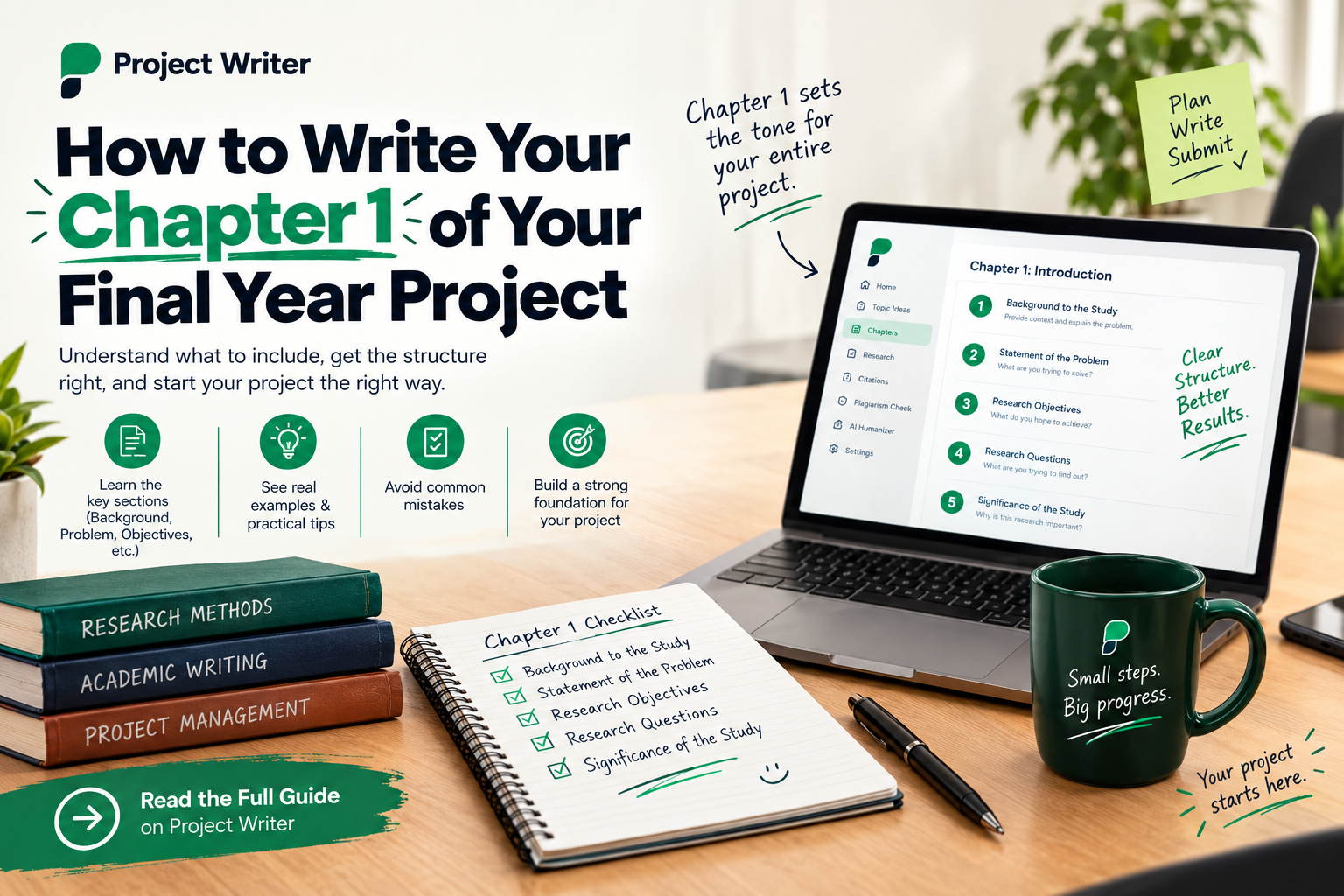
How to Write Your Chapter 1 of Your Final Year Project
A practical guide to writing Chapter 1 of your final year project, the standard sub-sections, common mistakes, and why writing it last often works better.

When You Should Start Writing Your Project
This post explores why students and researchers procrastinate on major writing tasks and how to break the cycle. It breaks down the main causes of last-minute stress like perfectionism and overwhelming project scopes and provides simple, step-by-step strategies to build writing momentum.