How to Write Your Chapter 1 of Your Final Year Project
ProjectWriter
October 3, 2026
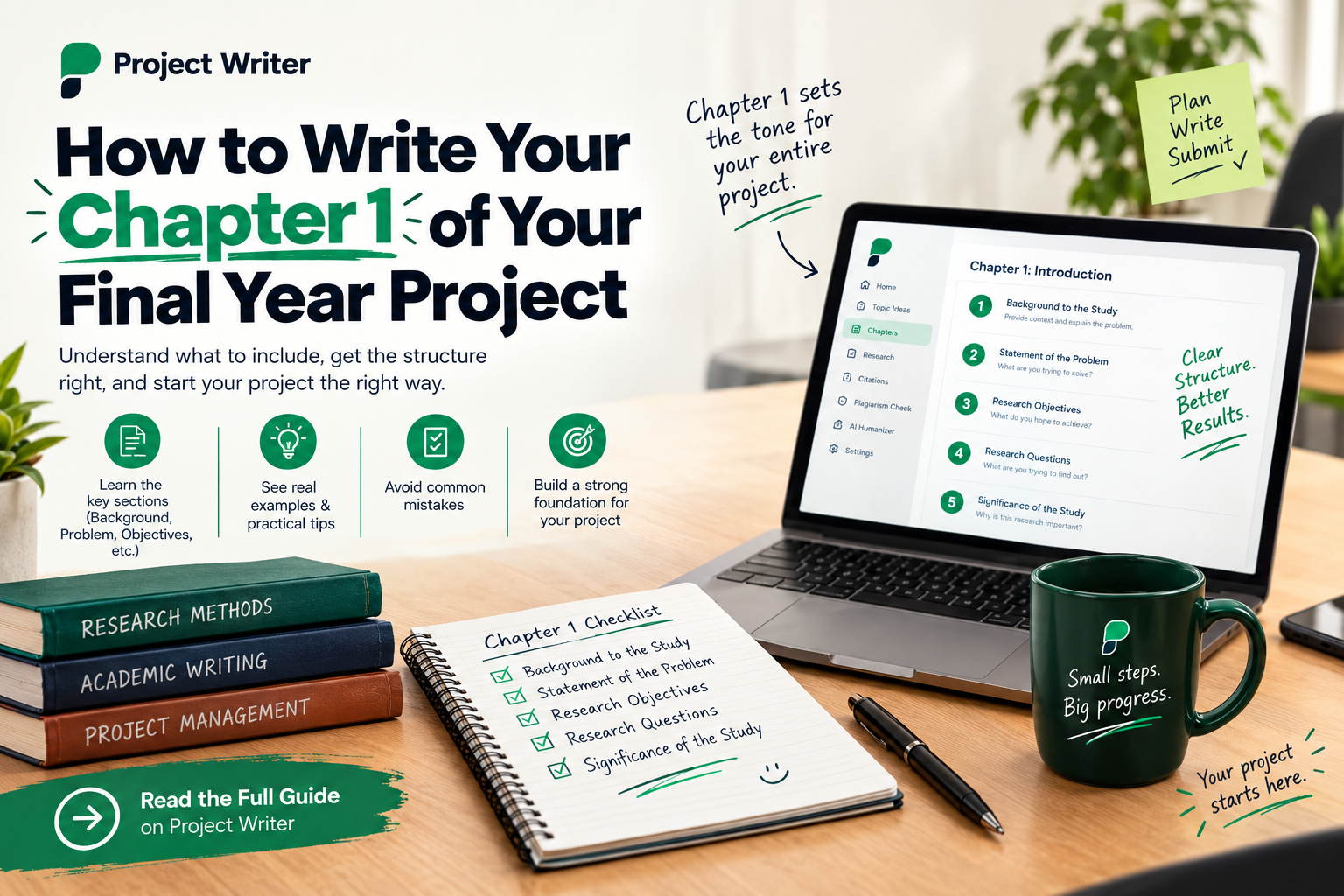
Chapter 1 is written first and read first, which is exactly why it's often the hardest chapter to get right. You're being asked to introduce a study you haven't actually finished thinking through yet. The objectives feel tentative, the scope keeps shifting, and it's tempting to just write something broad and move on.
That instinct is worth resisting. A vague Chapter 1 tends to signal a vague project, and supervisors notice within the first page whether a student actually knows what they're studying or is still figuring it out on the page.
What Chapter 1 actually needs to do
Its job is narrow: introduce the problem, not the whole subject area. A background section that opens with something like "communication has always been essential to human society" is trying to cover too much ground, and it delays the point by several paragraphs. Start closer to your actual topic and narrow from there, ideally within the first two or three sentences.
The standard sub-sections, with what actually goes in each
Sub-section | What it should actually contain |
|---|---|
Background of the study | The context for why this topic matters right now, in your specific setting, narrowing from the general field down to your exact problem area |
Statement of the problem | The specific gap or issue your project responds to, stated as a problem, not as a restatement of the background |
Objectives of the study | What you're actually trying to find out or achieve, usually written as short action statements: to determine, to examine, to assess |
Research questions or hypotheses | The objectives restated as things you can test or answer, phrased as questions or, for quantitative studies, as testable hypotheses |
Significance of the study | Who benefits from the answer and why it matters, named specifically rather than a general claim that the research "will be useful to researchers and policymakers" |
Scope and limitations | What the project covers, and what it deliberately leaves out, including population, timeframe, and geographic focus |
↔ Swipe to see more
Write it last, not first
This may be a controversial take, but it's the one that makes the biggest difference. Chapter 1 is easier and more accurate to write after your literature review and methodology are done, not before. By that point you actually know what your objectives are, what your research questions turned into once you started reading around them, and what your study realistically covers.
Writing it first often means rewriting it anyway once the rest of the project takes shape, since your methodology or your findings tend to shift your objectives slightly along the way. Writing it last means it only needs to be written once, and it usually reads as more confident, because you're describing a study you've actually finished thinking through instead of one you're still guessing at.
A quick example of narrowing the background
Compare two openings for a project on mobile banking adoption among small traders in Lagos. A background that starts broad might spend a full paragraph on the history of banking in Nigeria before ever mentioning mobile banking. A narrower version opens directly on mobile banking adoption rates among small traders, mentions the broader banking context in a single sentence for background, and reaches the specific problem, low adoption despite availability, within the first short paragraph. The second version gets a reader to the actual point roughly three times faster, without losing any necessary context.
Objectives and research questions have to match
This is one of the most common inconsistencies supervisors catch, and it's an easy one to avoid by checking the two sections against each other directly. If one of your objectives is to examine the relationship between mobile banking access and trader income, there should be a research question that asks exactly that, not a broader or narrower version of it. A mismatch here is often the first thing a supervisor flags, because it suggests the chapter wasn't reviewed as a whole before submission.
Where it usually goes wrong
Background that never narrows. If your background section is still talking in generalities by the third paragraph, it hasn't done its job.
Objectives that don't match research questions later on. Covered above, but worth repeating: read both sections back to back before you submit.
A significance section that's too generic. Claiming a study will be useful to "researchers, students, and policymakers" without saying how reads as filler. Name the specific group and the specific way they benefit.
Scope that's too vague to defend. "This study focuses on Nigerian students" isn't a scope, it's a population with no boundaries. Add the specific institution, timeframe, or region you're actually working within.
Where My Project Writer fits
Chapter 1 has a lot of small, easy to miss sub-sections, and it's simple to forget one or write two that contradict each other. My Project Writer gives you guided prompts for each sub-section, so nothing critical gets left out, and keeps your objectives and research questions aligned as you draft, instead of catching the mismatch during your defense.
FAQs
Do I really have to write Chapter 1 last?
Not strictly, but it's worth trying. Most students who write it first end up revising it heavily once the rest of the project is done, so writing it after your literature review and methodology usually saves time overall.
How long should Chapter 1 be?
This varies by department, but most run somewhere between 8 and 15 pages depending on how detailed the background and significance sections need to be. Check your department's own guideline for the expected range.
What's the difference between objectives and research questions?
Objectives state what you're trying to achieve, usually as action statements. Research questions restate those same goals as questions you can actually answer with your data. They should map onto each other directly.
How specific does the scope section need to be?
Specific enough that a reader knows exactly what your study does and doesn't cover. Naming your population, timeframe, and geographic focus is usually enough to make the scope clear.
Should limitations go in Chapter 1 or Chapter 5?
Most Nigerian universities expect a brief mention of anticipated limitations in Chapter 1, alongside scope, with a fuller discussion of actual limitations encountered in Chapter 5. Check your department's template, since this is one of the more variable sub-sections.
Can my significance section overlap with my objectives?
Some overlap is normal, but they should answer different questions. Objectives describe what you're doing. Significance describes who benefits once it's done and why that matters.
A QUICK DISCLAIMER
This reflects common practice across Nigerian universities, not a fixed template. Confirm your own department's expected sub-sections and structure before you finalize your chapter.
Reviews
No reviews yet — be the first.
More like this
Paraphrasing vs Plagiarism: What Every Final Year Student Needs to Know When Writing a Project
Learn the difference between paraphrasing and plagiarism, avoid common writing mistakes, cite sources correctly using My Project Writer to support your final-year project writing process with greater confidence.

12 Mistakes Nigerian Final Year Students Make
The same mistakes show up year after year, across departments, at almost every Nigerian university. Supervisors see them so often they can usually spot which stage a student is about to get stuck at before the student notices it themselves.

How to Avoid Plagiarism in Your Final Year Project
What actually counts as plagiarism beyond copy-paste, why it happens to careful students, and practical habits to keep your final year project original.

How to Write a Literature Review
A practical way to structure your final year project literature review by theme, avoid the most common mistakes, and actually land on your research gap.