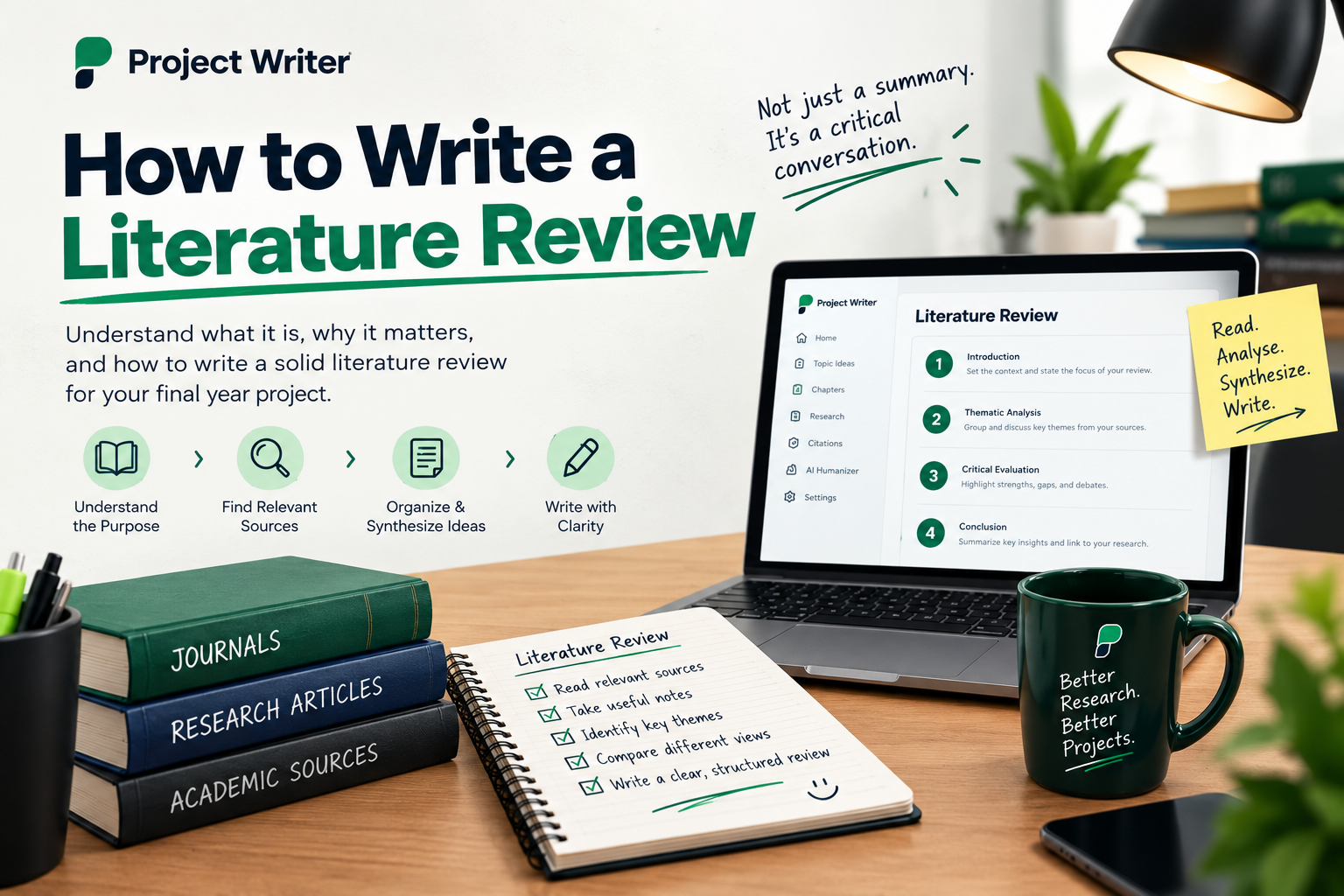
If you've got thirty tabs open, a stack of PDFs you've half read, and no idea how any of it turns into an actual chapter, you're not doing anything wrong. This is where most students get stuck, not because they haven't read enough, but because nobody explained what a literature review is actually for.
It isn't a summary of everything you've read. It's an argument. Specifically, it's the argument for why your project needs to exist, built out of what other researchers have already found, and what they haven't. Once you see it that way, the chapter stops feeling like an open-ended reading assignment and starts feeling like something with a clear finish line.
What a literature review actually is, and isn't
It isn't a list. Writing "Author A found X. Author B found Y. Author C found Z" one after another isn't a review, it's a bibliography with extra steps. A reader can tell within a paragraph whether you're summarizing or actually thinking.
It is a synthesis. You're grouping what's already known, pointing out where it agrees, where it conflicts, and where it stops short. Two studies that disagree with each other are more useful to you than two that repeat the same finding, because the disagreement is often where the interesting question lives.
It ends somewhere specific. A good literature review builds toward a clear statement: here's the gap, and here's what my project does about it. If a stranger read only your closing paragraph, they should understand exactly why your study needs to exist.
Summary versus synthesis, side by side
This is the single biggest thing that separates a passing literature review from a strong one, so it's worth seeing the difference in practice rather than just in theory.
Summary (weak) | Synthesis (strong) | |
|---|---|---|
Structure | One paragraph per author, in the order you read them | One section per theme, pulling in several sources at once |
Typical sentence | "Adeyemi (2023) found that mobile banking adoption was higher among urban youth." | Adoption research consistently links mobile banking uptake to urban access, though sources disagree on whether income or education is the stronger predictor. |
What it shows the reader | That you read the papers | That you understand how the papers relate to each other, and to your own study |
↔ Swipe to see more
A structure that actually works
Two habits separate a strong literature review from a weak one, and neither takes extra research, just a different way of organizing what you already have.
Group by theme, not by paper. Instead of walking through your sources one at a time, organize around the ideas or variables your study touches, and pull in multiple sources under each one. If your project is about social media and academic performance, your themes might be screen time and attention span, platform type and study habits, and parental controls and outcomes, each drawing on several sources at once.
Move from general to specific. Start with the broad context of your field, then narrow steadily until you land on the exact gap your project is built to fill. A review that stays broad the whole way through never quite explains why your specific study matters.
A worked example of grouping by theme
Say your topic is the influence of Twitter on political awareness among undergraduates. Instead of reviewing ten papers one by one, you might end up with three theme sections: social media use and civic engagement generally, platform-specific effects across Twitter, Instagram, and TikTok, and youth political behavior in the Nigerian context specifically. Each theme pulls in three or four of your ten sources, compares what they found, and ends with a short line on what's still unclear. By the time you've worked through all three themes, the gap your project fills has more or less written itself.
Where it usually goes wrong
Summarizing instead of synthesizing. If every paragraph starts with a different author's name and ends with what they found, you're describing the literature, not analyzing it. Try starting paragraphs with the idea instead of the author, something like: several studies link X to Y, though the strength of that link varies by context.
No gap statement at the end. A reader should finish your literature review already understanding why your study needs to exist. If they don't, the chapter hasn't done its job yet, no matter how many sources you cited.
Leaning on outdated sources. A review built mostly on sources from a decade ago reads as disconnected from where the field actually stands now. Aim for most of your sources to be from the last five to seven years, with older, foundational studies used sparingly for context.
Over-quoting instead of paraphrasing. A literature review stitched together from long direct quotes reads as under-processed. Paraphrase the finding in your own words and reserve direct quotes for the rare case where the original wording genuinely matters.
A simple process to actually write it
Gather 15 to 20 sources that are actually relevant to your topic. not just ones that mention it in passing.
Group them by theme or variable. You'll usually find 3 to 5 natural clusters once you lay them out.
Write each theme as its own short section, with your own synthesis connecting the sources rather than listing them.
Close with the gap. State plainly what hasn't been studied, or hasn't been studied in your specific context, and how your project addresses it.
Read it back as a stranger. Cover the author names and ask whether the paragraph still makes an argument. If it only makes sense with the names attached, it's still closer to a list than a synthesis.
Where My Project Writer fits
Sorting thirty sources into themes by hand is tedious, and it's where a lot of students lose momentum. My Project Writer pulls real sources from Google Scholar and groups them by theme automatically, so you're working from an organized starting point instead of a pile of open tabs. It helps structure the synthesis too, not just summarize each source in isolation, which is the actual skill a literature review is testing.
FAQs
How many sources do I actually need for a literature review?
15 to 20 relevant sources is a reasonable working range for most undergraduate projects. What matters more than the number is whether they're recent, directly relevant, and cover more than one angle on your topic.
Should I review every paper I found in my search?
No. Include the ones that genuinely inform your argument. A literature review with fewer, well chosen sources reads stronger than one padded out with tangential papers.
What's the difference between a literature review and an annotated bibliography?
An annotated bibliography summarizes each source on its own. A literature review connects them, groups them by theme, and builds toward an argument about what's missing from the existing research.
How do I know if I've found the actual gap in the research?
If you can name a specific question your context, your population, or your angle raises that existing studies haven't answered, you've found it. If your gap statement could apply to almost any topic, it probably needs to be more specific.
Is it okay to include a source I disagree with?
Yes, and it often strengthens the chapter. Showing where the literature disagrees, and offering your own read on why, demonstrates more critical thinking than only citing sources that support one view.
How long should the literature review chapter be?
This varies by department, but most run 12 to 20 pages for an undergraduate project. Check your own department's guideline rather than assuming a fixed length.
A QUICK DISCLAIMER
This is a general guide, not a replacement for your department's specific literature review requirements or your supervisor's feedback. Confirm your own university's expected structure and source count before you finalize the chapter.
Reviews
No reviews yet — be the first.
More like this
Paraphrasing vs Plagiarism: What Every Final Year Student Needs to Know When Writing a Project
Learn the difference between paraphrasing and plagiarism, avoid common writing mistakes, cite sources correctly using My Project Writer to support your final-year project writing process with greater confidence.

12 Mistakes Nigerian Final Year Students Make
The same mistakes show up year after year, across departments, at almost every Nigerian university. Supervisors see them so often they can usually spot which stage a student is about to get stuck at before the student notices it themselves.

How to Avoid Plagiarism in Your Final Year Project
What actually counts as plagiarism beyond copy-paste, why it happens to careful students, and practical habits to keep your final year project original.
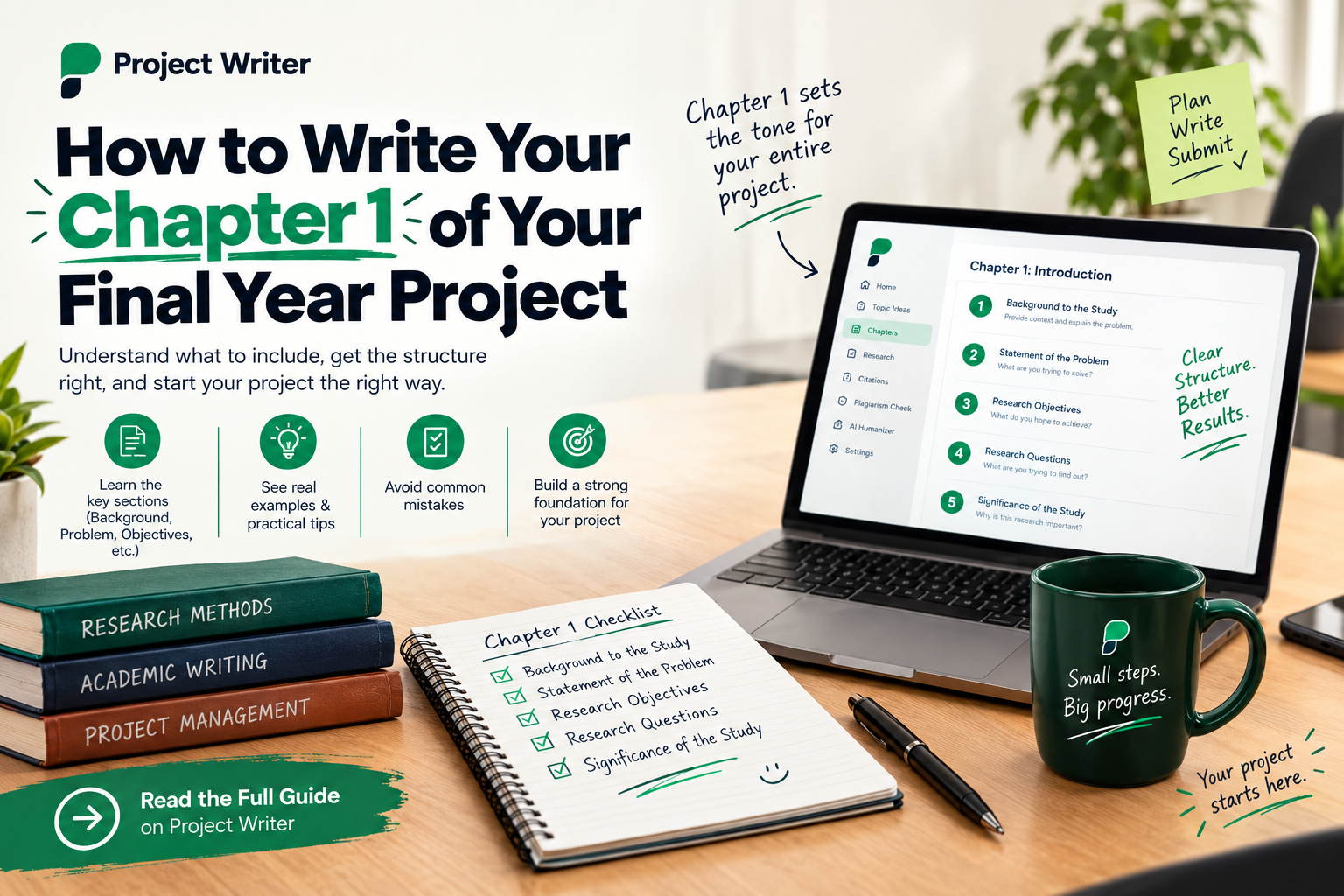
How to Write Your Chapter 1 of Your Final Year Project
A practical guide to writing Chapter 1 of your final year project, the standard sub-sections, common mistakes, and why writing it last often works better.