Paraphrasing vs Plagiarism: What Every Final Year Student Needs to Know When Writing a Project
ProjectWriter
October 16, 2026
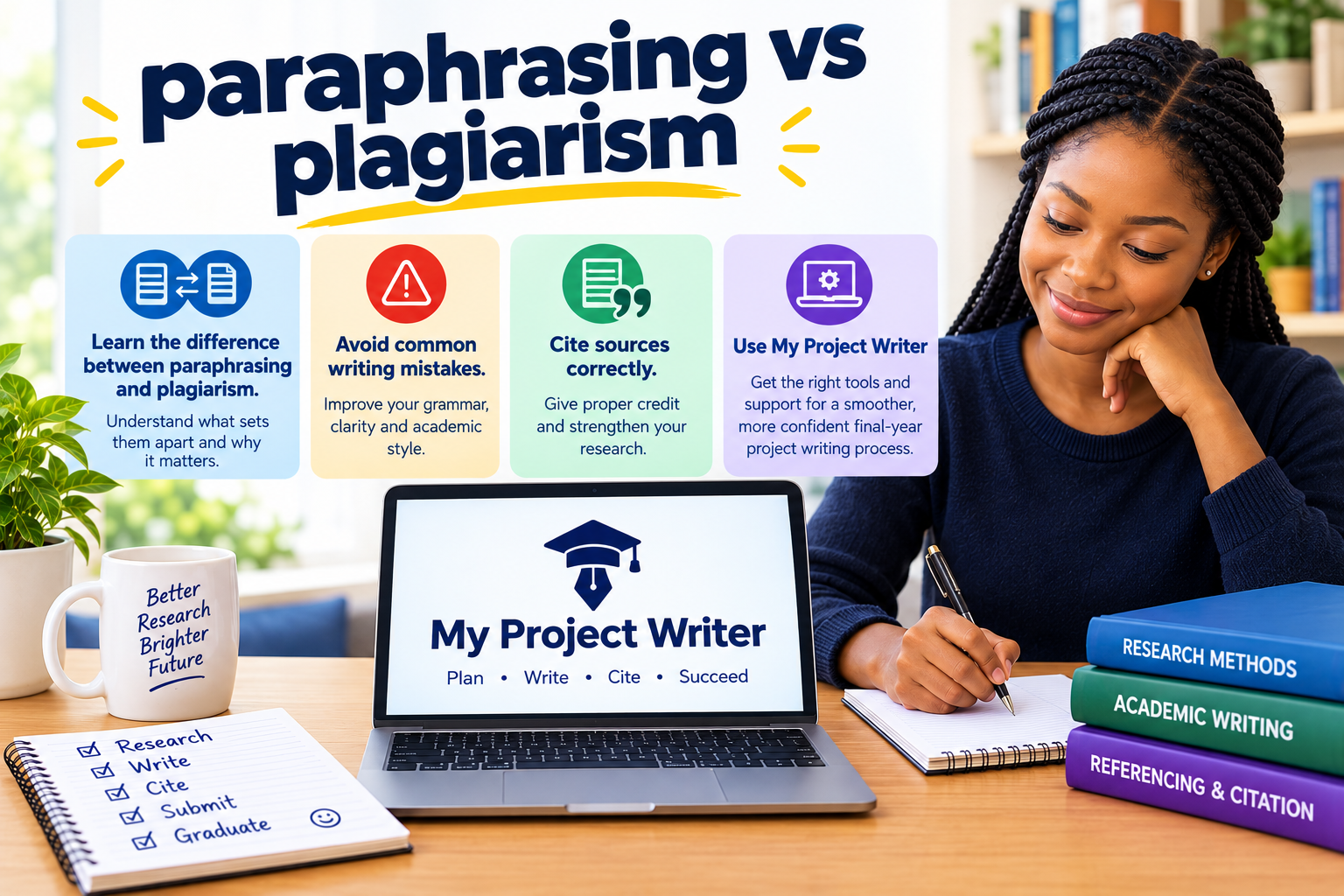
A sentence can be completely rewritten and still count as plagiarism. That is where many final-year students get into trouble.
You read an article, understand the idea, rewrite it in your own words, and move on to the next source. Your project looks original, so you assume everything is fine. But when your supervisor checks your work, you discover that something is wrong with your citations, your paraphrasing, or both.
The problem is not always that students deliberately copy other people’s work. Sometimes, they simply misunderstand what proper paraphrasing requires.
Knowing the difference between paraphrasing and plagiarism can save you from unnecessary revisions, awkward conversations with your supervisor, and potential academic misconduct issues. More importantly, it helps you write a project that reflects your understanding of the research rather than a collection of borrowed ideas.
Understanding the difference
Paraphrasing and plagiarism are related to how you use information from other sources, but they are not the same thing.
Paraphrasing means expressing another author’s idea in your own words and sentence structure while preserving the original meaning. In academic writing, you must still acknowledge the source of that idea, even when none of the original wording is retained.
Plagiarism occurs when you present someone else’s words, ideas, or work as your own without appropriate acknowledgment. This can happen through direct copying, inadequate paraphrasing, or using another person’s ideas without citing the source.
The key distinction is simple: paraphrasing is a legitimate research skill, while plagiarism is a breach of academic integrity. A paraphrase does not become acceptable simply because the words have changed.
Consider this example:
Original source:
“Poor sleep quality has been associated with reduced concentration and impaired academic performance among university students.”
Incorrect paraphrase:
“Poor sleep quality is linked to decreased concentration and poor academic performance among university students.”
The sentence has changed slightly, but most of its structure and key expressions remain the same. Without quotation marks or appropriate citation, this could be considered an inadequate paraphrase or plagiarism, depending on the context and institutional rules.
Better paraphrase:
“University students who do not sleep well may experience difficulties concentrating on their academic activities, which can affect their performance (Author, Year).”
The second version communicates the same central idea using a different sentence structure and wording, while acknowledging the original source.
The lesson? Changing a few words is not the same as paraphrasing, and changing every word does not remove the need to cite your source.
Writing mistakes that lead to plagiarism
Paraphrasing mistakes
Changing only a few words in a sentence. Replacing words with synonyms while retaining the original sentence structure can result in patchwriting. Read the source, understand its meaning, and express the idea independently instead of merely swapping words.
Forgetting to cite paraphrased ideas. Some students believe citations are necessary only when they use an author’s exact words. This is incorrect. Ideas obtained from other people’s research must be acknowledged, even when rewritten entirely.
Paraphrasing without understanding the source. When you do not fully understand what an author is saying, you are more likely to reproduce the original structure or misrepresent the findings. Understand the idea before attempting to explain it in your own words.
Citation Mistakes
Copying information without recording the source. Saving paragraphs from journal articles without noting their authors, publication years, or page details makes it difficult to reference them correctly later. Record source information as you research, not when submission is approaching.
Adding citations that do not support the claim. A reference should lead to a source that actually supports the statement being made. Do not attach a citation merely to make a paragraph look academic.
Using inconsistent referencing styles. Mixing APA, Vancouver, Harvard, or other referencing conventions can make your work appear poorly prepared and may violate departmental requirements. Follow the style prescribed by your department and apply it consistently.
AI and research mistakes
Submitting AI-generated text without proper verification. AI tools can produce inaccurate claims, misleading citations, or text that does not reflect your actual understanding of a topic. Verify the information against reliable sources and follow your institution’s rules on AI use and disclosure.
Assuming a low similarity score means there is no plagiarism. Similarity reports identify matching text; they do not independently determine whether plagiarism has occurred. An uncited idea may be plagiarized even if it shares very little wording with other documents.
Relying on AI detection scores as proof of originality. AI detectors can produce false positives and false negatives. A detector’s result should not be treated as definitive proof that a student did or did not use AI.
Research and writing mistakes
Writing your literature review as a collection of copied ideas. A literature review should demonstrate your understanding of existing research. Group related findings, compare authors’ conclusions, identify disagreements, and explain how the literature relates to your study instead of presenting one borrowed paragraph after another.
Confusing common knowledge with specialized information. General facts may not require citations, but specific statistics, research findings, theories, and claims usually do. When in doubt, consult your department’s guidelines and cite the source of specialized information.
Failing to distinguish your contribution from existing research. Your project should make it clear which ideas come from previous studies and which interpretations, analyses, or conclusions are your own. Proper attribution helps readers understand the difference.
Submission mistakes
Skipping a plagiarism check before submission. Reviewing your work early can help you identify passages that need better paraphrasing, missing citations, or quotation marks. Leave enough time to investigate and correct the issues rather than waiting until your supervisor flags them.
Checking only the similarity percentage. A low percentage does not automatically mean your work is free from plagiarism, and a high percentage does not necessarily mean misconduct has occurred. Examine the matched passages and assess whether each has been appropriately quoted, cited, or paraphrased.
Leaving referencing corrections until the last minute. Citation errors become more difficult to fix when you have forgotten where information came from. Maintain accurate references throughout the writing process and check your in-text citations against your reference list before submission.
A quick reference: paraphrasing vs plagiarism
Situation | What it means | What to do |
Rewriting an author’s idea in your own words and citing the source | Proper paraphrasing | Preserve the meaning and cite the original work |
Replacing a few words while keeping the original sentence structure | Potential patchwriting | Rework the sentence independently and cite the source |
Copying a sentence without quotation marks or attribution | Potential direct plagiarism | Quote accurately, cite the source, or paraphrase properly |
Paraphrasing an idea but omitting the citation | Potential plagiarism | Add the appropriate citation |
Using an AI-generated reference without checking it | Risk of inaccurate referencing | Verify that the source exists and supports the claim |
Receiving a low similarity score | Limited evidence about text overlap | Review the report and assess originality and attribution manually |
↔ Swipe to see more
Where My Project Writer Fits
My Project Writer is designed to make the research and writing process easier by helping students manage important parts of their projects without leaving every check until the final submission stage.
When you are working on a literature review, paraphrasing research findings, or preparing your final draft, keeping track of originality and referencing can become overwhelming. My Project Writer brings useful writing support features into the workflow.
Here is where it fits:
Plagiarism checks: Identify potentially matching passages that may need closer review, improved paraphrasing, or more appropriate citations.
AI-detection checks: Review text for signals that an AI detector may flag. These results should be interpreted cautiously because AI detection is not definitive proof of authorship.
Citation support: Help keep citations and referencing consistent, reducing the burden of manually checking formatting across your project.
Consistent formatting: Maintain a more organized document instead of spending the final days correcting headings, spacing, and other formatting inconsistencies.
Draft management: Keep your writing organized as you work through your chapters, making it easier to continue developing your project.
Think of My Project Writer as a research and writing companion, not a substitute for your understanding or academic judgment. It can support your workflow, but you are still responsible for verifying sources, understanding the material, citing borrowed ideas, and following your institution’s academic integrity policy.
The goal is not simply to produce a project that passes a similarity check. It is to produce work you can confidently explain and defend.
FAQs
Is paraphrasing without citation considered plagiarism?
Yes, it can be. If the idea comes from another author’s work, you generally need to cite that source even when you have completely rewritten the sentence. Paraphrasing changes how an idea is expressed, not who originally developed it.
How much of a sentence must I change to paraphrase properly?
There is no universal percentage or number of words you must change. Effective paraphrasing involves understanding the original idea and expressing it independently using your own wording and sentence structure, while retaining the intended meaning and citing the source.
Can a project have a 0% plagiarism score and still contain plagiarism?
Yes. A similarity checker may not identify every instance of unattributed borrowing, particularly when ideas have been substantially reworded. A zero similarity score is not a guarantee of academic integrity.
What similarity percentage is acceptable for a final-year project?
There is no single acceptable percentage across all Nigerian universities or departments. Requirements differ by institution, faculty, and assignment. Follow your department’s guidelines and pay attention to the actual matched passages rather than relying on the percentage alone.
Can My Project Writer help me avoid plagiarism?
My Project Writer includes plagiarism and AI-detection checks to support your writing workflow. These features can help you identify text that deserves further review, but they cannot guarantee that a project is plagiarism-free. You still need to verify your sources, cite borrowed ideas, and revise your work responsibly.
A QUICK DISCLAIMER
Academic integrity policies and referencing requirements vary across Nigerian universities, departments, and research programmes. Always follow your institution’s guidelines and your supervisor’s instructions regarding paraphrasing, citation, plagiarism checks, and AI-assisted writing. Similarity and AI-detection tools are aids to review, not definitive judgments of academic misconduct.
Reviews
No reviews yet — be the first.
More like this
How to Avoid Plagiarism in Your Final Year Project
What actually counts as plagiarism beyond copy-paste, why it happens to careful students, and practical habits to keep your final year project original.
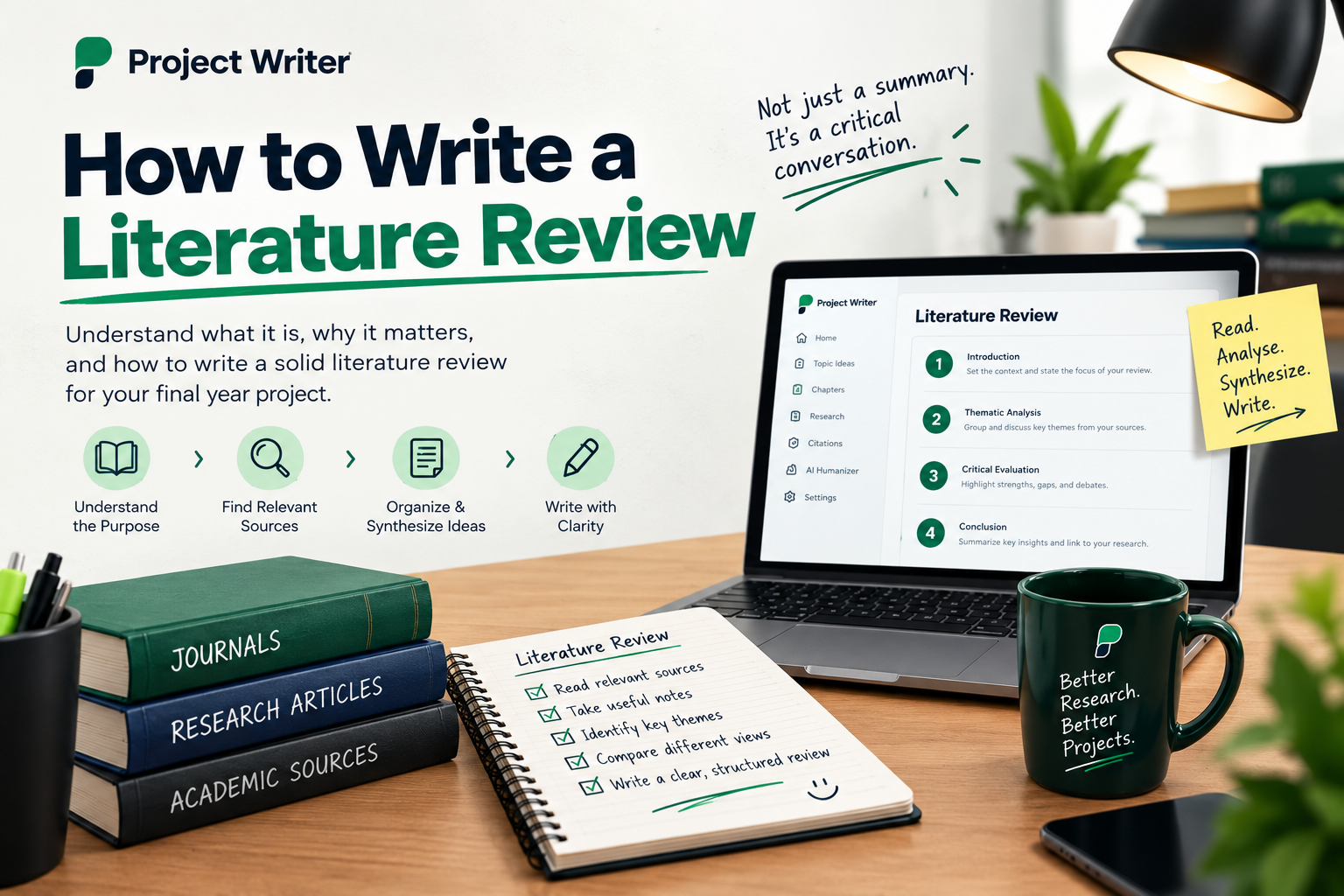
How to Write a Literature Review
A practical way to structure your final year project literature review by theme, avoid the most common mistakes, and actually land on your research gap.
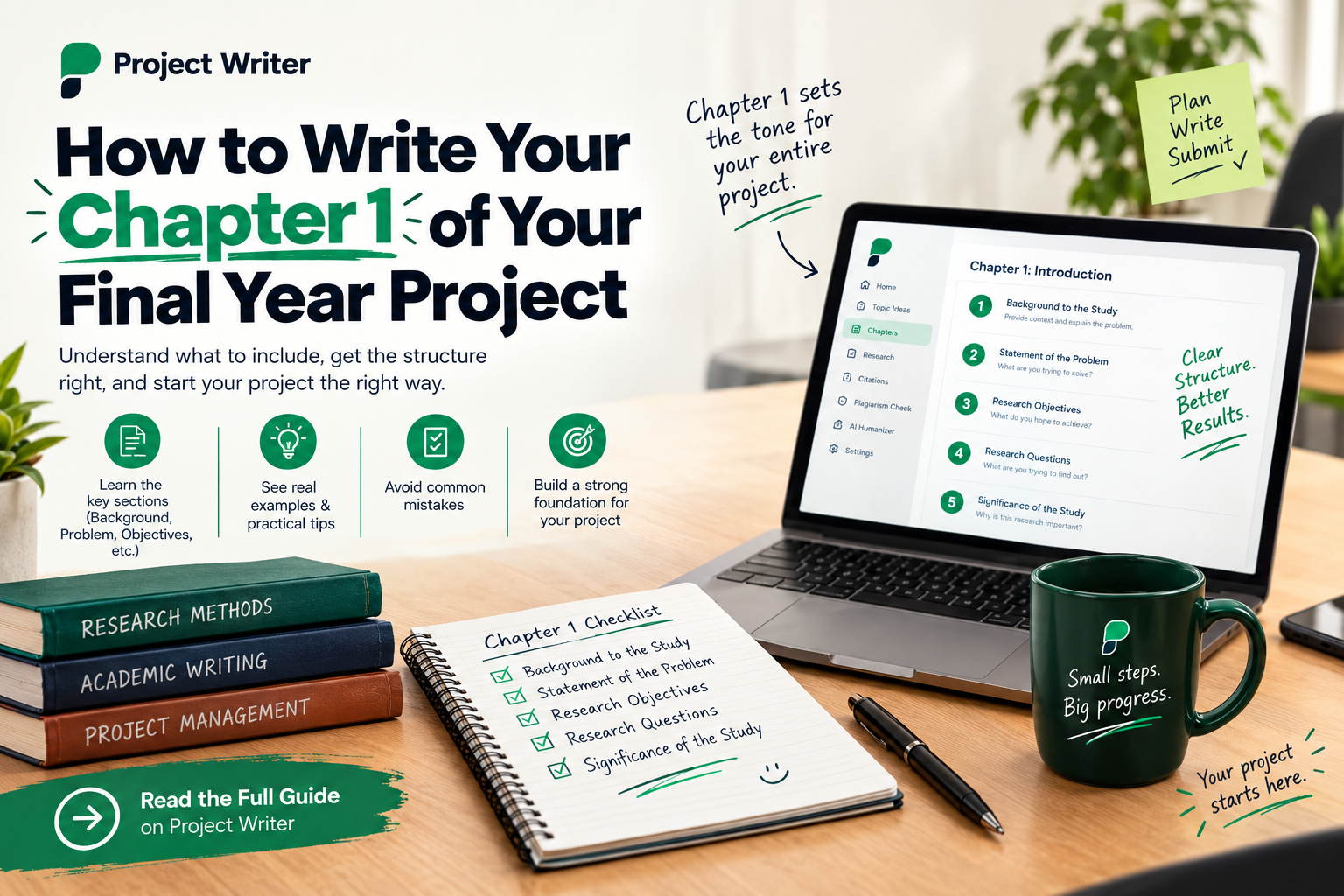
How to Write Your Chapter 1 of Your Final Year Project
A practical guide to writing Chapter 1 of your final year project, the standard sub-sections, common mistakes, and why writing it last often works better.
How to Choose a Final Year Project Topic That Actually Gets Approved
A step by step way to pick a final year project topic your supervisor approves fast, plus how to narrow it down and check it's actually researchable.