How to Choose a Final Year Project Topic That Actually Gets Approved
ProjectWriter
September 9, 2026
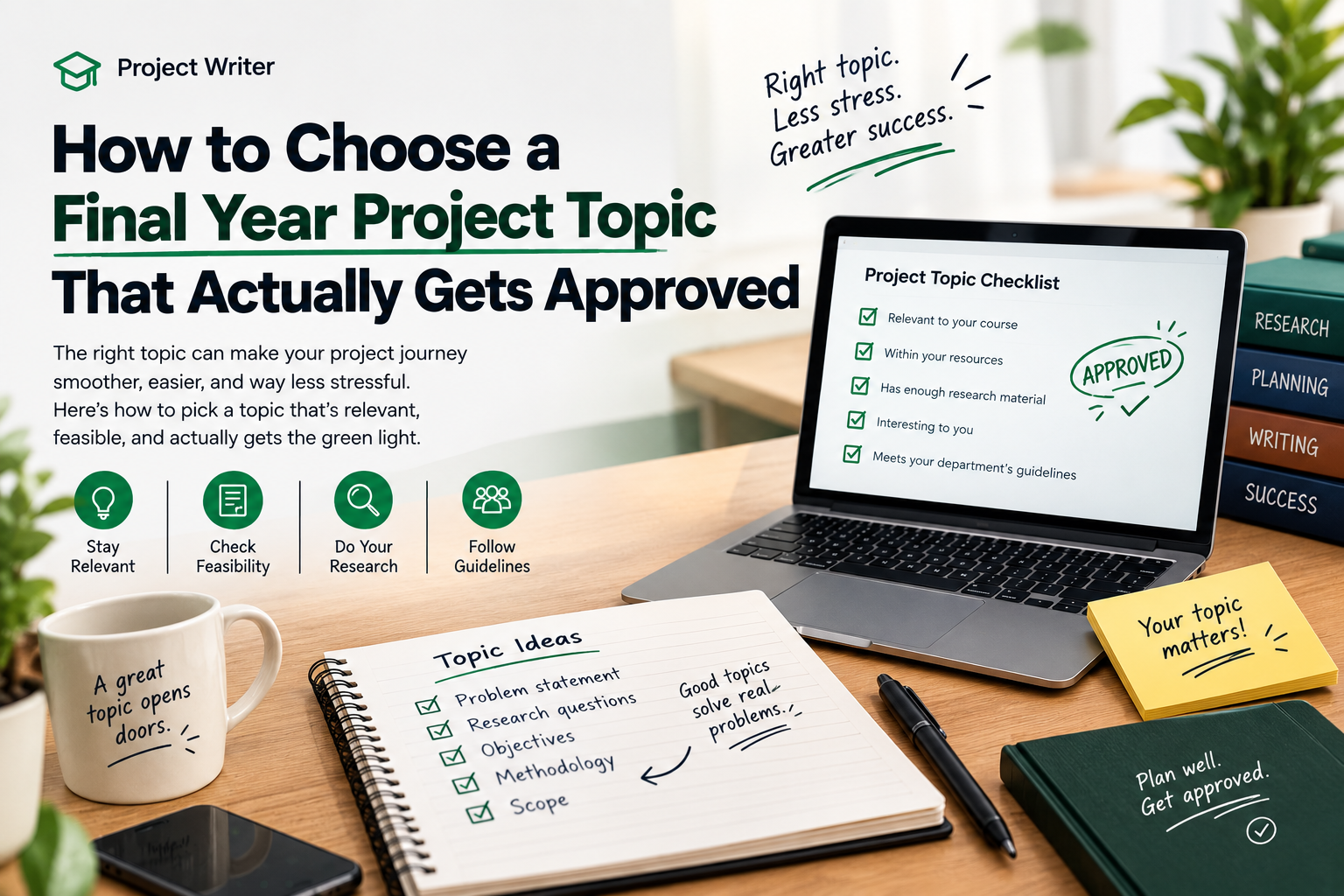
Choosing your topic is, without question, the most important decision you'll make in your final year. Get it right and everything ( supervisor approval, data collection, your literature review, your defense) gets easier. Get it wrong and you could be stuck revising your topic for weeks before you've even started Chapter 1.
Here's how to actually pick a topic that gets approved on the first or second try, without the back-and-forth that eats into your semester.
Why Your Topic Matters More Than You Think
A weak topic doesn't just risk rejection, it makes the rest of your project much harder than it needs to be. Your topic decides:
How fast your supervisor approves you. Clear, focused topics get signed off quickly. Vague ones bounce back with questions.
Whether you can actually get the data. A topic that sounds great but has no accessible respondents or datasets will keep you till the end of the semester..
How original your work looks. A sharp, specific angle stands out. An overused topic invites plagiarism flags and unimpressed examiners.
Whether it's useful beyond graduation. A well-chosen topic can double as a portfolio piece for job applications or a postgrad application later.
The Step-By-Step Approach
Start with your department's approved areas. Most Nigerian universities publish approved topics or thematic areas by department. Start there so you're not proposing something outside your faculty's scope from day one.
Find a real problem or gap. Ask yourself: what actual challenges exist in my field, in Nigeria specifically? What has previous research missed or gotten wrong? Can I realistically measure or analyze this in 3–4 months?
Narrow it down. "Impact of Social Media in Nigeria" is too broad to defend. Instead, get specific about your population (e.g., undergraduates at UNILAG), your platform or subject (e.g., TikTok vs. Instagram), and your outcome (e.g., academic performance, political awareness).
Confirm your data is actually accessible. Before you commit: can you reach your respondents, datasets, or case studies? Are there ethical restrictions to worry about? Is there enough existing literature to build a real Chapter 2?
Run it through a topic generator. Once you've got a direction, this is where My Project Writer's Instant Topic Generation earns its place. Feed it your field and interests, and it turns your brainstorm into supervisor-ready, academically phrased topic options in seconds , instead of you guessing at the right wording.
How My Project Writer's Topic Generation Works
My Project Writer is trained on academic literature and built specifically for final-year research, so the topics it generates aren't just AI-sounding titles , they're structured the way your department actually expects.
What it does | Why it matters |
|---|---|
Analyzes your field of study | Suggests topics that fit your department's standards, not generic ones |
Keeps a formal academic tone | Outputs research-worthy titles, not clickbait phrasing |
Grounds suggestions in Google Scholar | Cuts down on hallucinated or irrelevant topics |
Generates in seconds | Turns hours of brainstorming into a shortlist you can react to |
↔ Swipe to see more
Example workflow:
You input: "Mass Communication, social media, youth political engagement, Nigeria"
It generates options like the ones below, then you refine , pick the one that fits, narrow the scope further if needed, and take it to your supervisor.
"The Influence of Twitter on Political Awareness Among Undergraduates in Southwest Nigeria (2020–2025)"
"Framing of Electoral Issues on Instagram: A Content Analysis of Nigerian Youth-Oriented Pages"
"Social Media as a Tool for Political Mobilization: A Case Study of #EndSARS and University Students in Lagos"
Pro Tips Before You Lock It In
Lean toward your supervisor's area of expertise. Topics close to what they already research get faster, more useful feedback.
Use local context. A Nigerian-specific case study is easier to defend and stands out more than a generic international one.
Avoid the obviously overused topics. "Impact of ICT on Education" has been done to death , add a real angle, like rural secondary schools in Kano.
Don't wait to start. Run your topic through the generator in Week 1, not Week 3, so you actually have time to revise if your supervisor pushes back.
Final Checklist Before You Submit Your Topic
☐ It's specific, measurable, and realistic within one semester
☐ At least 10–15 relevant sources exist for your literature review
☐ Your data collection method is clear , survey, interview, experiment, or content analysis
☐ It's passed through My Project Writer's generator for tone and relevance
☐ Your supervisor has given at least preliminary approval
Combine structured brainstorming with My Project Writer's Instant Topic Generation, and most students can go from "I have no idea what to write about" to a supervisor-approved topic in under an hour.
FAQs
How long should choosing a topic actually take?
With a structured approach, a day or two , not weeks. The delays usually come from vague topics bouncing back from supervisors, not from the initial brainstorming.
Can I just pick any topic I'm interested in?
Only if it's also feasible, meaning you can access the data and defend it within your timeline. Interest matters, but feasibility is what actually gets you through the semester.
What makes a topic "too broad"?
If you can't name your specific population, platform, or outcome in one sentence, it's too broad. Narrow it until it is.
Does My Project Writer's generator replace talking to my supervisor?
No, think of it as getting you to a strong first draft faster, so the conversation with your supervisor is about refining a solid topic instead of starting from a blank page.
A QUICK DISCLAIMER
Tools like My Project Writer are there to speed up your brainstorming and formatting, the final topic still needs your judgment and your supervisor's approval. Always confirm your university's specific policy on AI-assisted work before you submit.
Reviews (1)
Lolia N.
Sep 9, 2026More like this
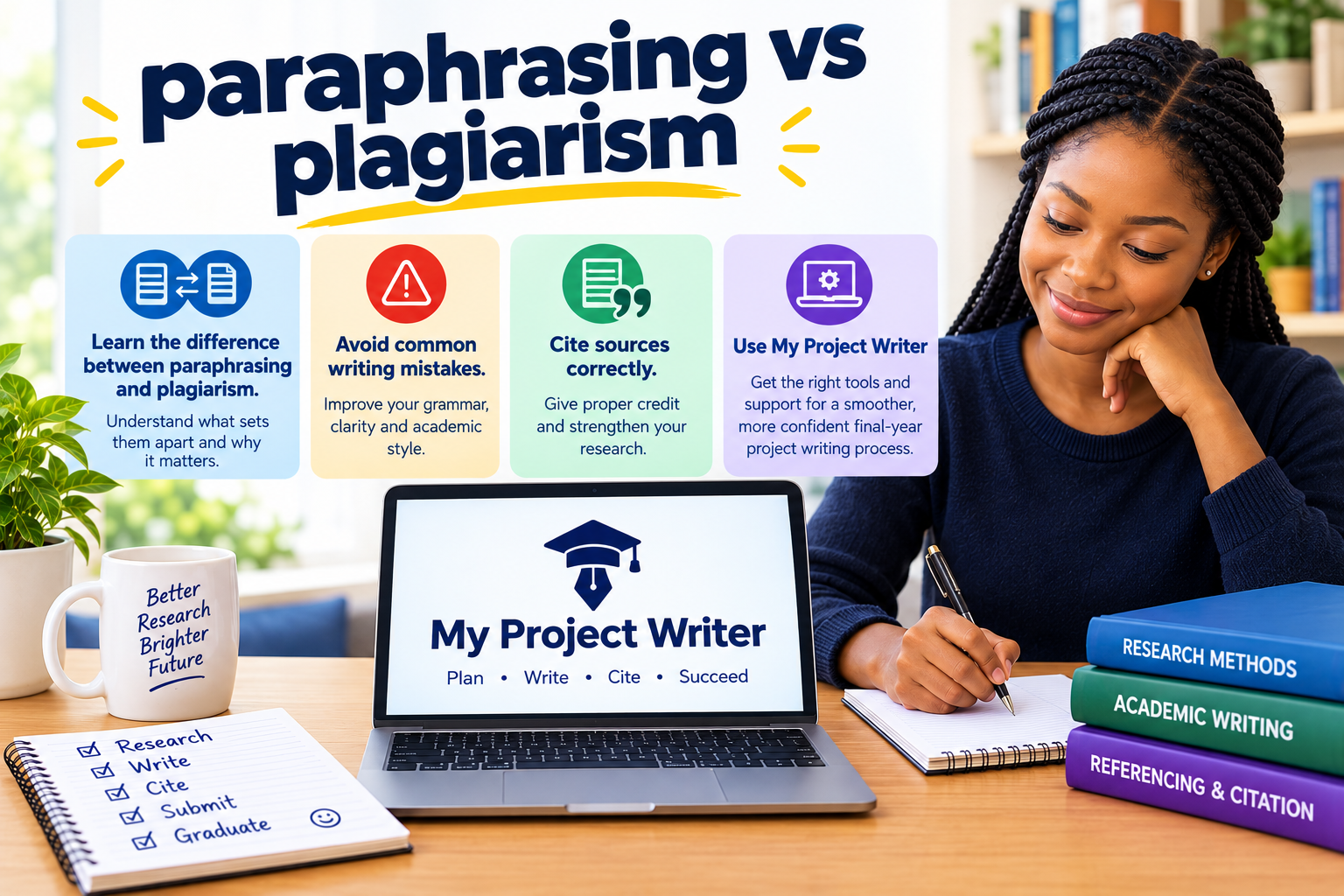
Paraphrasing vs Plagiarism: What Every Final Year Student Needs to Know When Writing a Project
Learn the difference between paraphrasing and plagiarism, avoid common writing mistakes, cite sources correctly using My Project Writer to support your final-year project writing process with greater confidence.
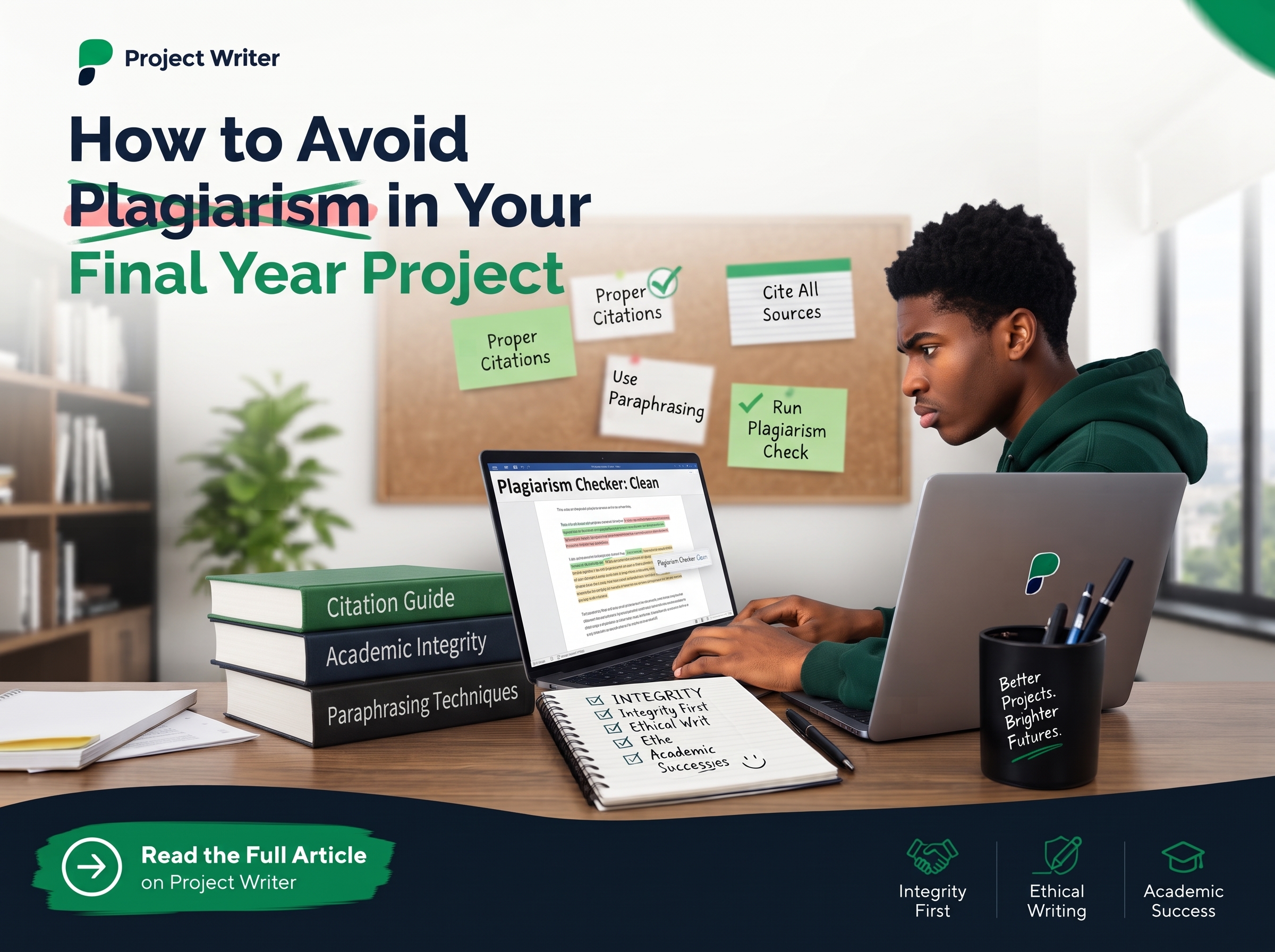
How to Avoid Plagiarism in Your Final Year Project
What actually counts as plagiarism beyond copy-paste, why it happens to careful students, and practical habits to keep your final year project original.
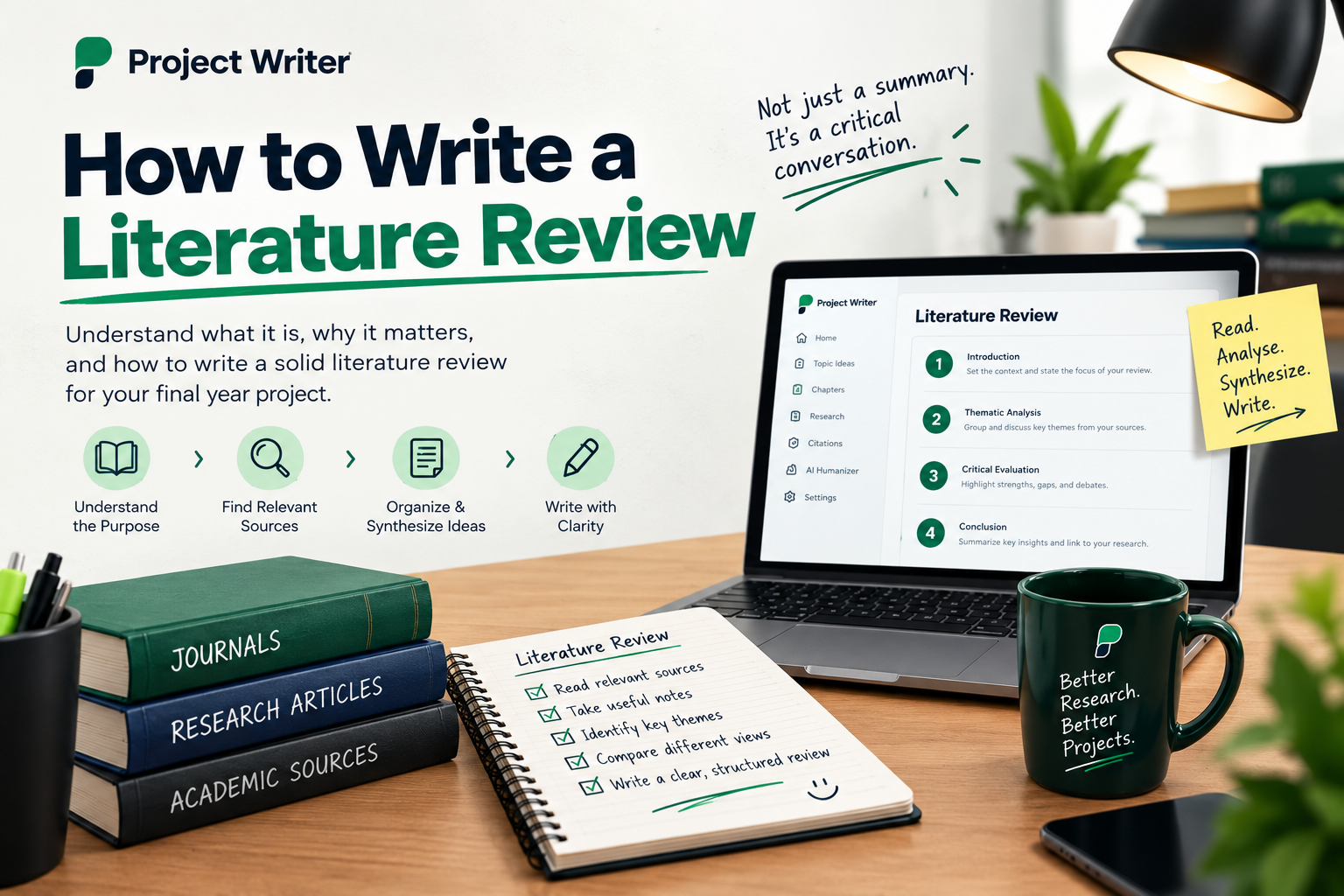
How to Write a Literature Review
A practical way to structure your final year project literature review by theme, avoid the most common mistakes, and actually land on your research gap.
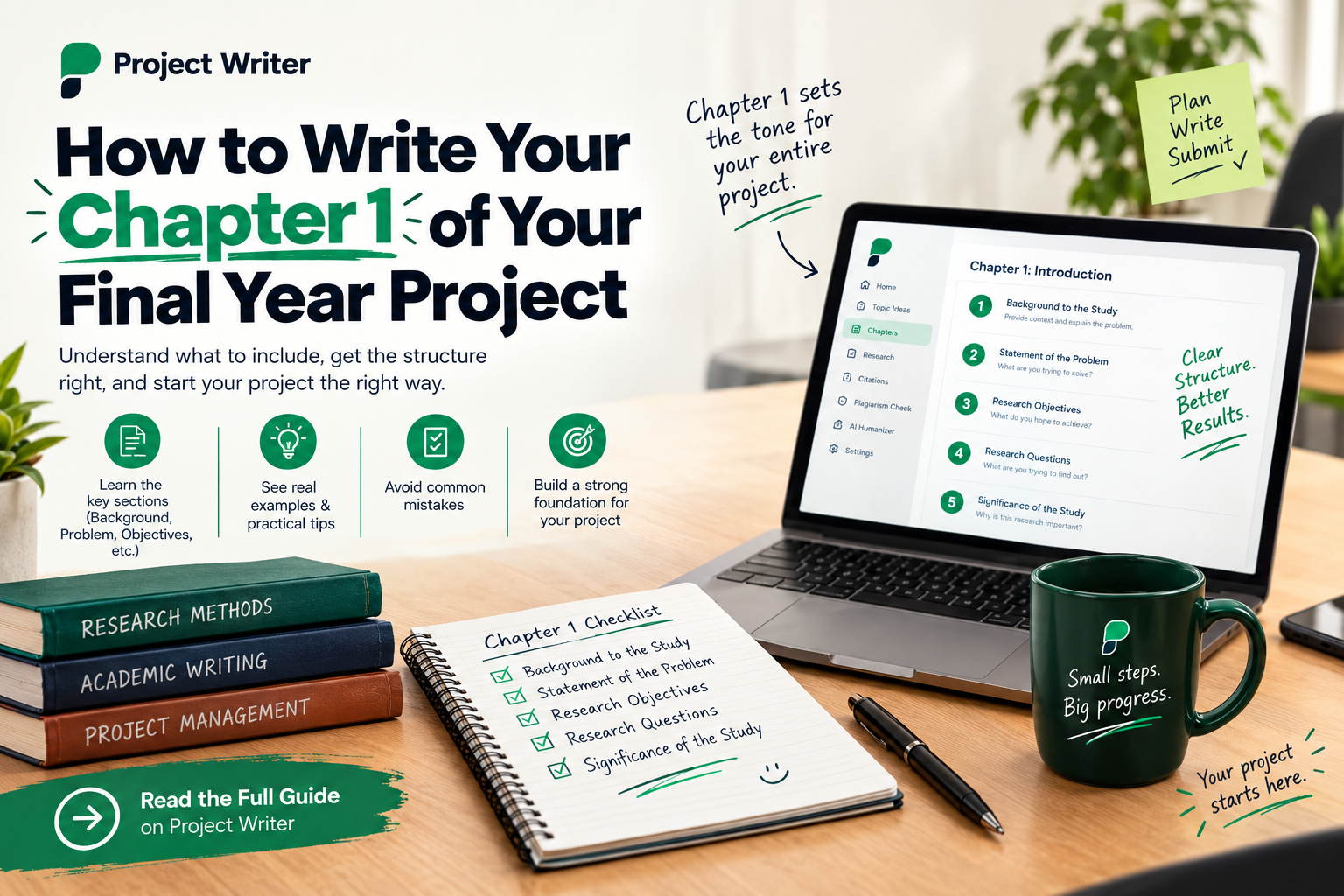
How to Write Your Chapter 1 of Your Final Year Project
A practical guide to writing Chapter 1 of your final year project, the standard sub-sections, common mistakes, and why writing it last often works better.