How to Avoid Plagiarism in Your Final Year Project
ProjectWriter
October 3, 2026
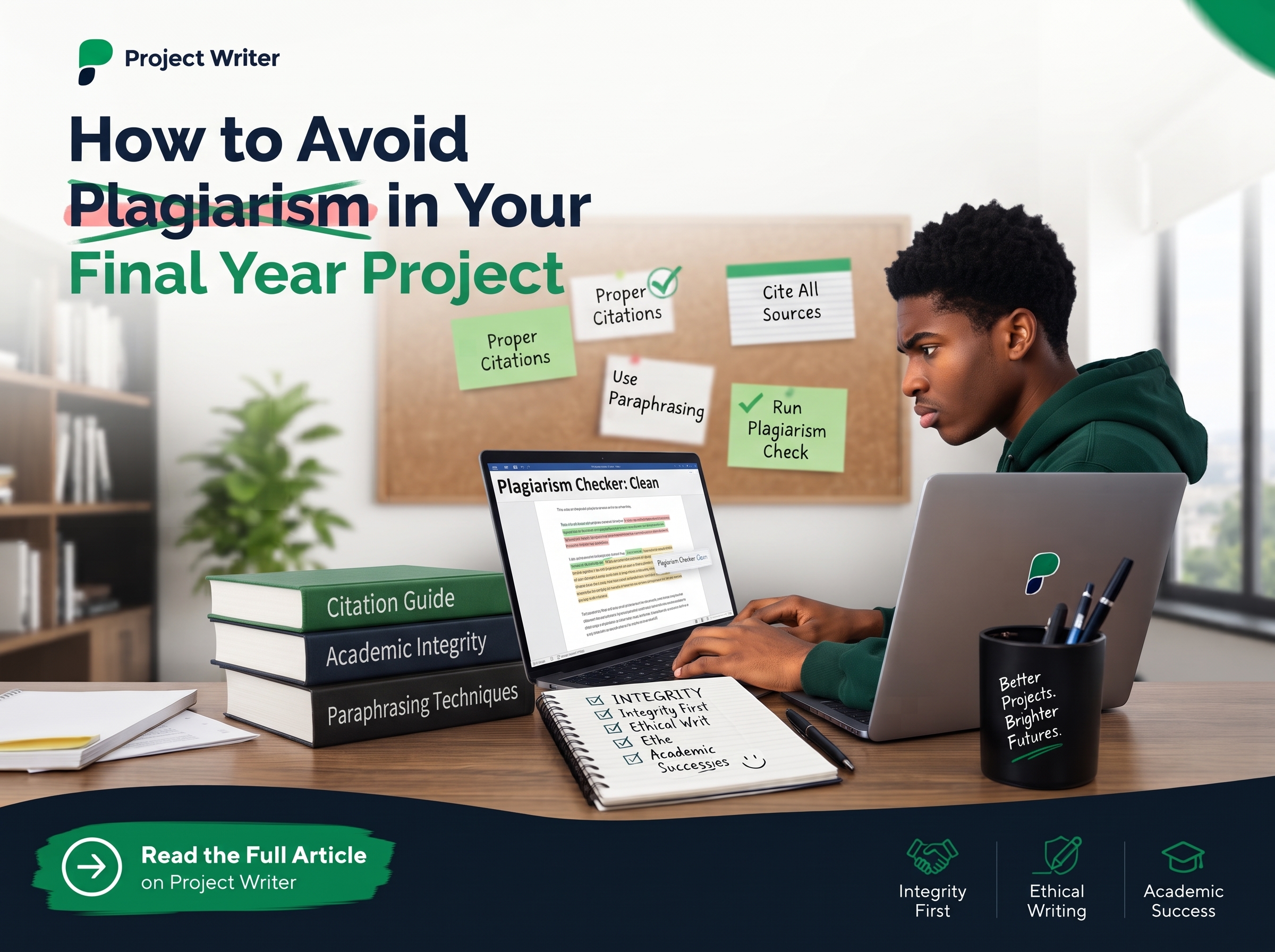
Plagiarism can delay or fail a project, and most students who get flagged for it didn't set out to cheat. It usually happens quietly: a sentence that stayed too close to the source it came from, a note copied down weeks ago without a citation attached, a paragraph paraphrased while the original was still open in the next tab.
Knowing what actually counts, and building a few habits early, makes this much easier to avoid than most students expect. None of what follows requires extra research, just a different way of working while you write.
What counts as plagiarism, beyond copy-paste
Close paraphrasing without citation. Changing a few words while keeping the original sentence structure and argument still counts, even without a direct copy-paste. Similarity checkers are specifically built to catch this pattern.
Self-plagiarism. Reusing your own earlier coursework without disclosing it is still a form of plagiarism at most institutions, even though it's your own writing. If part of your project draws on an earlier assignment, say so.
Uncredited data or figures. A table or chart pulled from another source needs a citation just as much as a quoted sentence does, including data you've redrawn or reformatted yourself.
Patchwriting. Stitching together phrases from several sources, lightly reworded, without any citation. It's often unintentional, usually from working across too many open tabs at once, but it's treated the same as direct copying.
What weak paraphrasing actually looks like
It helps to see this side by side rather than just described. Here's the same idea handled three different ways.
Version | Example |
|---|---|
Original source | Mobile banking adoption remains significantly higher among urban youth compared to their rural counterparts. |
Close paraphrase (still a problem) | Mobile banking uptake stays considerably higher for urban young people versus rural ones. (Same structure, same claim, a few words swapped, no citation.) |
Genuine paraphrase with citation | Urban location and youth appear to be strong predictors of mobile banking adoption, a pattern this study explores further in a specific Lagos trading context (Author, Year). |
↔ Swipe to see more
Why it happens even to careful students
Two patterns explain most accidental plagiarism. The first is paraphrasing with the source still open, which makes it almost impossible not to mirror the original's structure and phrasing, even unintentionally. The second is losing track of which notes came from which source after weeks of research, so a fact gets written down without its citation and never gets one added back. Both are workflow problems, not honesty problems, which is exactly why they're fixable with better habits rather than more willpower.
Habits that actually prevent it
Cite while you write, not after. Adding the citation the moment you use a source takes seconds. Going back to find it later, across dozens of sources, takes hours and things get missed.
Keep a running reference list from day one. Every source you read goes on the list immediately, whether you end up citing it or not. It's much easier to remove an unused entry than to hunt one down later.
Paraphrase from memory. Close the source, write the idea in your own words from what you remember, then check back against the original to confirm accuracy. This naturally produces different sentence structure instead of a disguised copy.
Separate your notes from your draft. Keep raw notes and quotes in one document, clearly marked, and your actual writing in another. Mixing the two makes it easy to accidentally paste a note straight into your chapter without rewording it.
What about group work and shared resources?
If you're working with classmates on data collection, or sharing a set of sources within a study group, the writing itself still needs to be your own. Shared data or shared reading lists are fine and common, but if two students submit chapters with near-identical wording built from the same shared notes, that's still flagged as plagiarism between the two submissions, not just against outside sources. Write your own analysis even when the underlying material was gathered together.
Checking before you submit
Run a plagiarism check yourself before your supervisor or Turnitin does. It's far better to catch a flagged section while you can still fix it than to find out during your defense. Acceptable similarity scores vary by school, so check your department's specific threshold rather than assuming a general number, but seeing exactly which sections are flagged, and why, lets you fix the actual problem instead of guessing at which paragraph caused it.
Where My Project Writer fits
My Project Writer's built-in plagiarism scanner checks your originality before submission, not after it's too late to fix anything. It also includes an AI-detection check, since flagged AI patterns are increasingly reviewed alongside similarity scores at defense, and it flags specific sections rather than just returning a single overall score, so you know exactly what to revise.
FAQs
What's considered an acceptable similarity score?
This varies by university and sometimes by department, so there's no single universal number. Check your own institution's specific policy rather than relying on a general figure you've heard elsewhere.
Does citing a source protect me from a plagiarism flag?
A citation credits the idea, but if your wording still closely mirrors the original, a similarity checker can still flag it. Both the citation and genuinely reworded language matter.
Can I get flagged for reusing my own earlier coursework?
Yes, this is called self-plagiarism, and most institutions require you to disclose it if you're building on your own prior work rather than presenting it as entirely new.
Should I run a plagiarism check on a rough draft or only the final version?
Both are useful. Checking a rough draft early gives you time to fix structural issues, like over-reliance on one source. A final check before submission confirms nothing was missed.
Is it plagiarism if the similarity is with my own reference list or table of contents?
No, most checkers exclude reference lists, and standard structural elements are normal to share across projects in the same department. What matters is similarity in your actual written analysis.
What should I do if I get flagged and I genuinely wrote it myself?
This can happen with common phrasing or shared source material. Revise the flagged section to differ more clearly in structure and wording, and keep your original notes in case you need to show your own research process to your supervisor.
A QUICK DISCLAIMER
Plagiarism policies and acceptable similarity thresholds vary by institution. Always confirm your own university's specific requirements before submission, and treat any plagiarism checker as a safeguard, not a replacement for citing carefully as you write.
Reviews
No reviews yet — be the first.
More like this
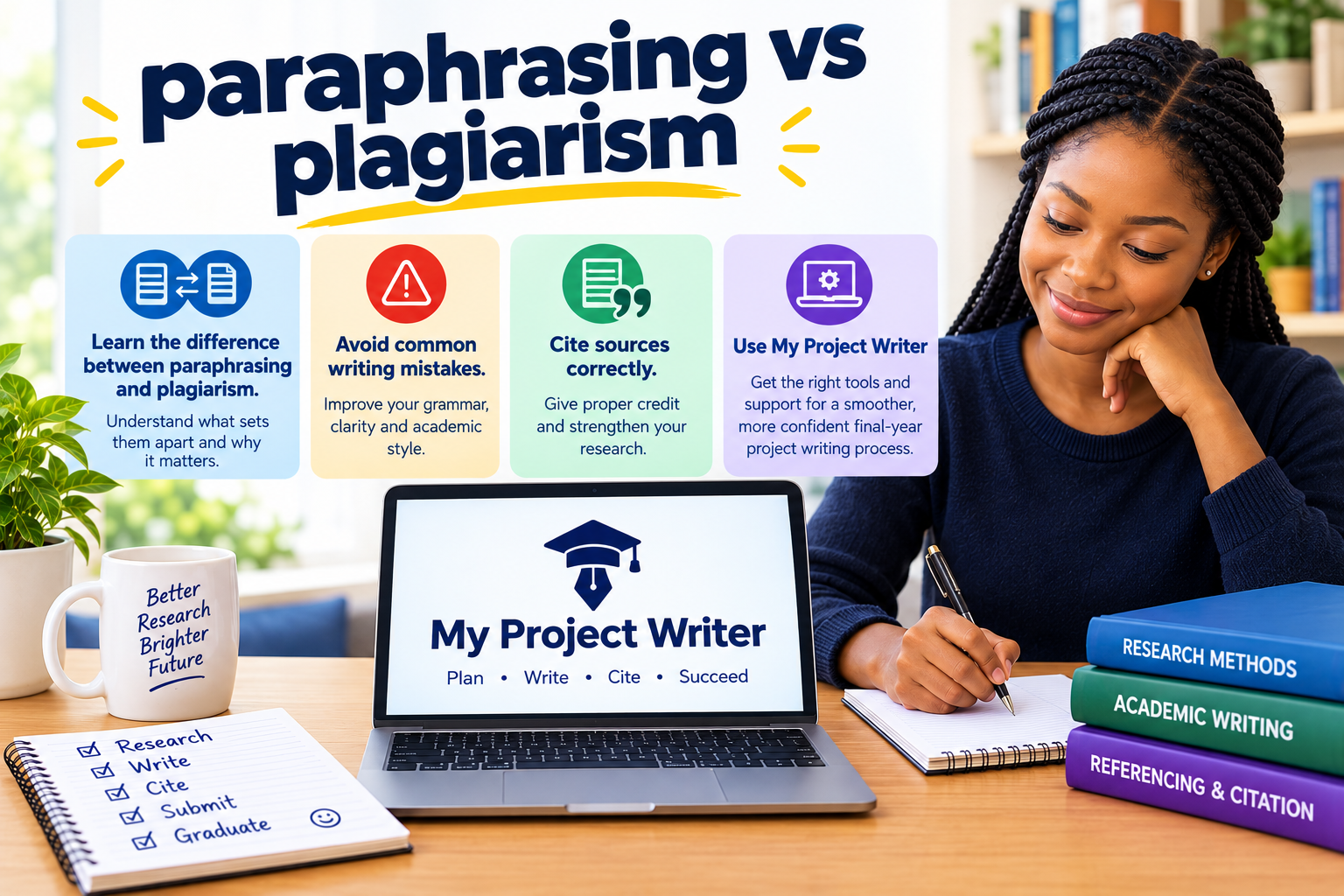
Paraphrasing vs Plagiarism: What Every Final Year Student Needs to Know When Writing a Project
Learn the difference between paraphrasing and plagiarism, avoid common writing mistakes, cite sources correctly using My Project Writer to support your final-year project writing process with greater confidence.
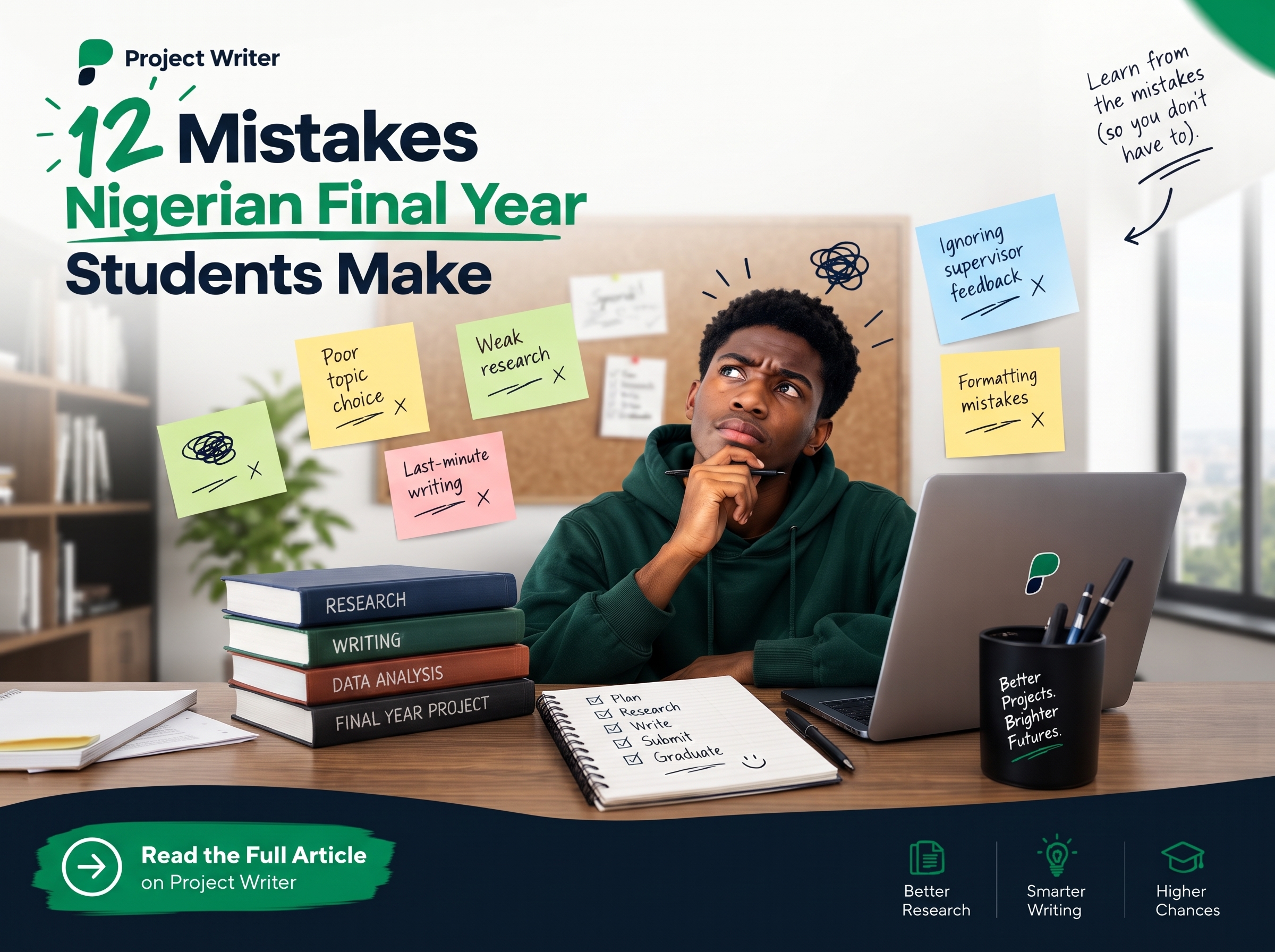
12 Mistakes Nigerian Final Year Students Make
The same mistakes show up year after year, across departments, at almost every Nigerian university. Supervisors see them so often they can usually spot which stage a student is about to get stuck at before the student notices it themselves.
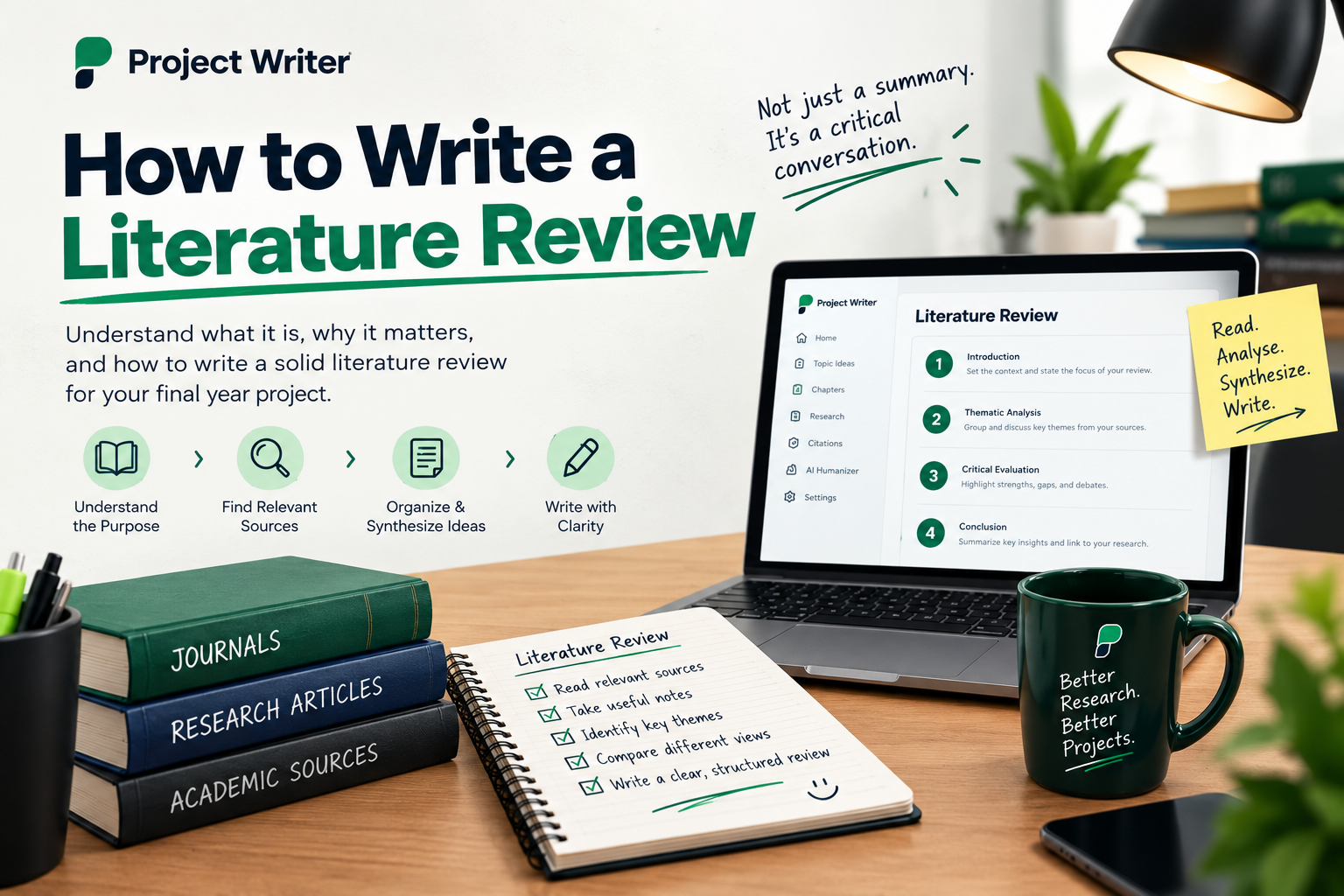
How to Write a Literature Review
A practical way to structure your final year project literature review by theme, avoid the most common mistakes, and actually land on your research gap.
How to Write Your Chapter 1 of Your Final Year Project
A practical guide to writing Chapter 1 of your final year project, the standard sub-sections, common mistakes, and why writing it last often works better.