The final year project format in Nigeria is usually five chapters: Introduction, Literature Review, Methodology, Data Presentation and Analysis, and Summary, Conclusion and Recommendations. These come after the preliminary pages (title page, certification, dedication, acknowledgement, abstract and tables of contents) and before the references and appendices. Your department may tweak the order or add sections, so always check your handbook, but this is the structure most supervisors expect. A copy-and-paste template is further down this page.
Most students don't struggle because the format is hard. They struggle because nobody lays out the whole thing in one place, so each chapter turns into a surprise. This guide walks through the full project from the first page to the last, with what goes where and what supervisors tend to look for.
The standard layout at a glance
Part | What it contains | Where students slip |
|---|---|---|
Preliminary pages | Title page, certification, dedication, acknowledgement, abstract, contents lists | Wrong page numbering, missing list of tables |
Chapter 1: Introduction | Background, problem, objectives, questions, hypotheses, significance, scope | Vague problem statement |
Chapter 2: Literature Review | Conceptual, theoretical and empirical review, gap in the literature | Summarizing instead of synthesizing |
Chapter 3: Methodology | Design, population, sample, instrument, validity, analysis method | No justification for sample size |
Chapter 4: Data Analysis | Tables, interpretation, test of hypotheses, discussion | Tables with no explanation in words |
Chapter 5: Summary and Conclusion | Summary of findings, conclusion, recommendations, contributions | Recommendations that don't follow from the findings |
End matter | References and appendices | Mixed citation styles |
↔ Swipe to see more
Preliminary pages
These are the pages before Chapter 1, and they are usually numbered with small Roman numerals (i, ii, iii). The common order is:
Title page. Project title, your full name, matriculation number, department, faculty, university, the degree being awarded (for example, B.Sc. Accounting) and the month and year of submission.
Certification. A page confirming the work was carried out by you and supervised by your named supervisor, with space for signatures from the supervisor and the Head of Department.
Dedication and acknowledgement. Short and sincere. Keep the dedication to a line or two and use the acknowledgement to thank your supervisor, family and anyone who helped.
Abstract. A one-page summary of the problem, method, main findings and conclusion. Write it last, even though it appears first. See our guide on how to write an abstract for a project.
Table of contents, list of tables, list of figures. Generate these from your heading styles so they update automatically.
Chapter 1: Introduction
Chapter 1 tells the reader what you are studying and why it matters. Typical sections are:
Background to the study. Start broad, then narrow to your topic and your setting, such as a Nigerian industry, institution or community.
Statement of the problem. The specific gap or issue your study responds to. This is the section supervisors read most closely. Here is how to write one: statement of the problem with examples.
Objectives of the study. Usually one general objective and three to five specific ones, each starting with a verb such as "to examine" or "to determine".
Research questions and hypotheses. One question per specific objective. Quantitative studies also state null and alternative hypotheses.
Significance, scope and limitations. Who benefits, what you cover, and what you could not cover. See significance, scope and limitations of the study.
Definition of terms. Some departments ask for this. Define terms the way you use them in your study.
A tip many supervisors give: it is often easier to finalize Chapter 1 after your literature review and methodology are settled, because your objectives tend to sharpen once you have done the reading.
Chapter 2: Literature Review
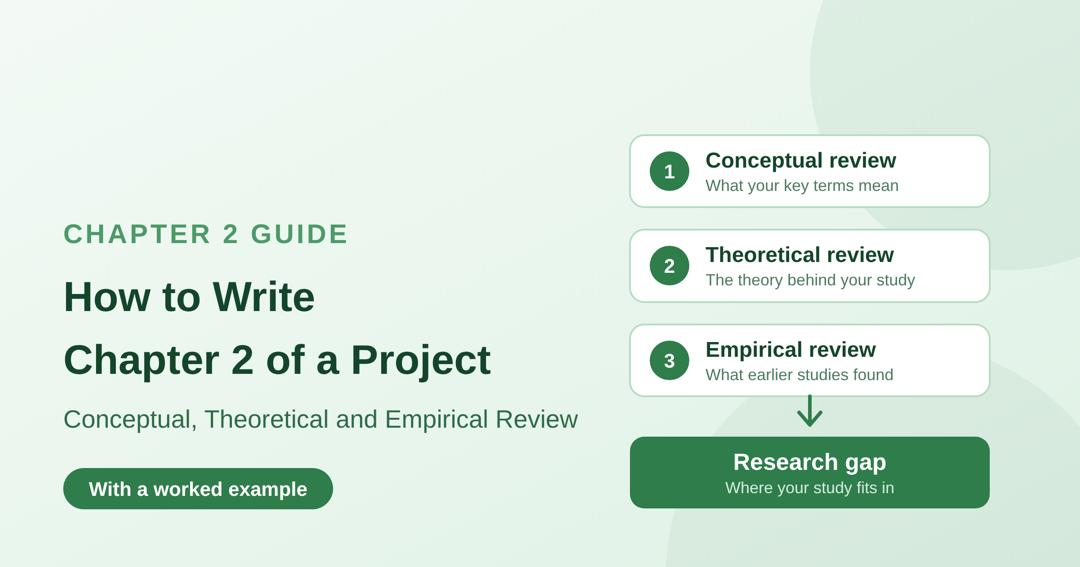
This is where you show what is already known and where your study fits. The Nigerian three-part structure is:
Conceptual review. Define and explain the key concepts in your topic.
Theoretical framework. Pick one or two theories that explain the relationships in your study and say why they fit.
Empirical review. Summarize previous studies, grouped by theme rather than listed author by author, and end by stating the gap your study fills.
Chapter 3: Research Methodology
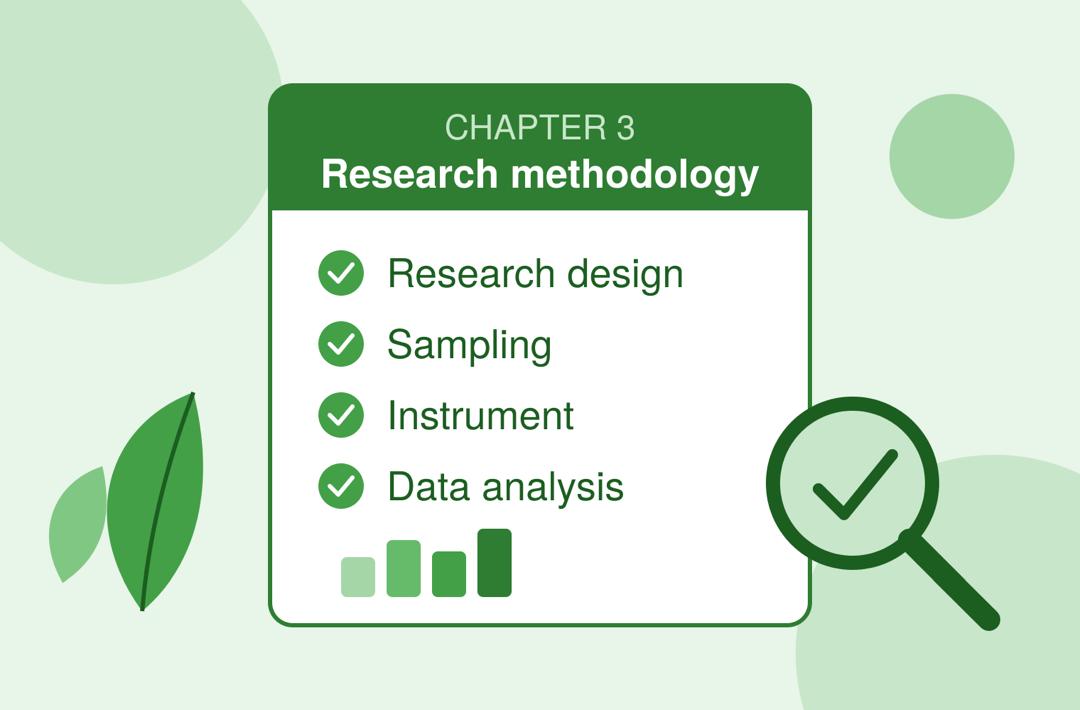
Chapter 3 explains exactly how you carried out the study, in enough detail that someone else could repeat it. Most projects include:
Research design. For example, survey, case study or experimental design, and why it suits your questions.
Population of the study. The full group you are interested in.
Sample size and sampling technique. How many respondents and how you chose them, with the reasoning.
Instrument for data collection. Questionnaire, interview guide or observation checklist.
Validity and reliability. How you checked the instrument works.
Method of data analysis. The tools you will use, such as descriptive statistics, regression or thematic analysis.
Ethical considerations. Consent and confidentiality.
See Chapter 3 research methodology with an example.
Chapter 4: Data Presentation, Analysis and Discussion
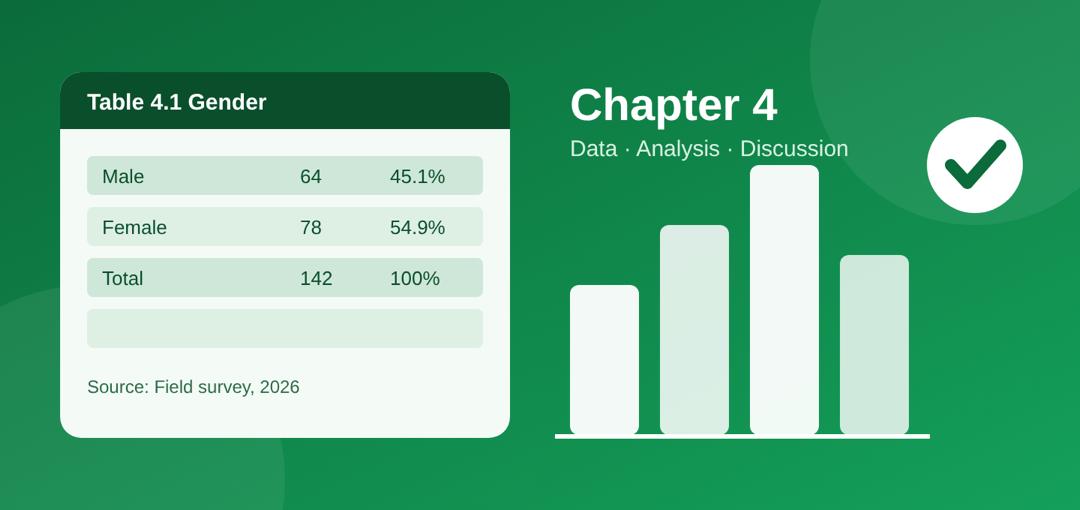
Chapter 4 is where your results appear. Present the data in tables or charts, then explain each one in plain sentences. A table with no interpretation is one of the most common reasons chapters get sent back.
Start with the response rate and the respondents' demographic profile.
Answer each research question in order, using the same numbering as Chapter 1.
Test your hypotheses and state the decision clearly (reject or fail to reject the null).
Close with a discussion that links your findings back to the literature in Chapter 2.
Chapter 5: Summary, Conclusion and Recommendations
This chapter wraps up the work. Keep each part separate:
Summary of findings. The key results, one short paragraph or a few bullet points, without new data.
Conclusion. What the findings mean in light of your objectives.
Recommendations. Practical suggestions that follow directly from your findings, addressed to the people who can act on them.
Contribution to knowledge and suggestions for further study. Included by many departments, especially at higher levels.
References and appendices
References. Use the style your department requires, often APA, and keep in-text citations and the reference list matching.
Appendices. Your questionnaire, interview guide, consent form and any extra tables. Label them Appendix A, B and so on.
Formatting basics
Formatting rules differ by university and department, but these are common starting points. Treat them as defaults and replace them with your department's own guide where one exists:
Times New Roman, 12 pt for body text
1.5 or double line spacing
Wider left margin to allow for binding
Chapter headings centered and in capitals, with consistent heading levels below them
Page numbers in Roman numerals for preliminary pages and Arabic numerals from Chapter 1
Set these once at the start using heading styles so you aren't fixing every chapter the night before submission.
Free template: copy and adapt
PRELIMINARY PAGES
  Title Page
  Certification
  Dedication
  Acknowledgement
  Abstract
  Table of Contents
  List of Tables
  List of Figures

CHAPTER ONE: INTRODUCTION
  1.1 Background to the Study
  1.2 Statement of the Problem
  1.3 Objectives of the Study
  1.4 Research Questions
  1.5 Research Hypotheses
  1.6 Significance of the Study
  1.7 Scope of the Study
  1.8 Limitations of the Study
  1.9 Definition of Terms

CHAPTER TWO: LITERATURE REVIEW
  2.1 Introduction
  2.2 Conceptual Review
  2.3 Theoretical Framework
  2.4 Empirical Review
  2.5 Summary of Literature and Research Gap

CHAPTER THREE: RESEARCH METHODOLOGY
  3.1 Introduction
  3.2 Research Design
  3.3 Population of the Study
  3.4 Sample Size and Sampling Technique
  3.5 Instrument for Data Collection
  3.6 Validity and Reliability of the Instrument
  3.7 Method of Data Analysis
  3.8 Ethical Considerations

CHAPTER FOUR: DATA PRESENTATION, ANALYSIS AND DISCUSSION
  4.1 Introduction
  4.2 Response Rate and Demographic Data
  4.3 Analysis of Research Questions
  4.4 Test of Hypotheses
  4.5 Discussion of Findings

CHAPTER FIVE: SUMMARY, CONCLUSION AND RECOMMENDATIONS
  5.1 Summary of Findings
  5.2 Conclusion
  5.3 Recommendations
  5.4 Contribution to Knowledge
  5.5 Suggestions for Further Study

REFERENCES
APPENDICES
Where ProjectWriter fits
ProjectWriter is built around this five-chapter structure. When you start a project, it sets up the chapters and headings for you, keeps your formatting consistent as you write, and keeps your citations and reference list aligned automatically. It also runs plagiarism and AI-detection checks as part of the workflow and saves your drafts as you go. Start your project in ProjectWriter and get the chapter structure set up in minutes.
FAQs
What is the standard format for a final year project in Nigeria?
Most Nigerian universities use five chapters: Introduction, Literature Review, Methodology, Data Presentation and Analysis, and Summary, Conclusion and Recommendations. These are preceded by preliminary pages and followed by references and appendices.
How many chapters should a project have?
Five is the most common answer. Some departments, especially in engineering, sciences or design-based courses, use a different number or rename chapters, so confirm with your supervisor.
How many pages should a final year project be?
It depends on your department and level. Many undergraduate projects fall somewhere between 50 and 100 pages, but your handbook's guidance overrides any general rule.
Does the format differ between universities?
The five-chapter skeleton is widely shared, but details like referencing style, margins, numbering and required sections vary by university and even by department. Ask for your department's project guide at the start.
Which chapter should I write first?
Many students start with the literature review and methodology, then write Chapter 1 once their objectives are clear. Chapter 4 follows data collection and the abstract goes last.
What referencing style do Nigerian universities use?
APA is very common, but some departments prefer Harvard, MLA or others. Use whichever your department specifies and apply it consistently from the start.
A quick disclaimer
This layout reflects a common structure across Nigerian universities, but every department has its own requirements and every supervisor has preferences. Confirm your department's guidelines and your supervisor's expectations rather than relying only on general advice.
Reviews
No reviews yet — be the first.