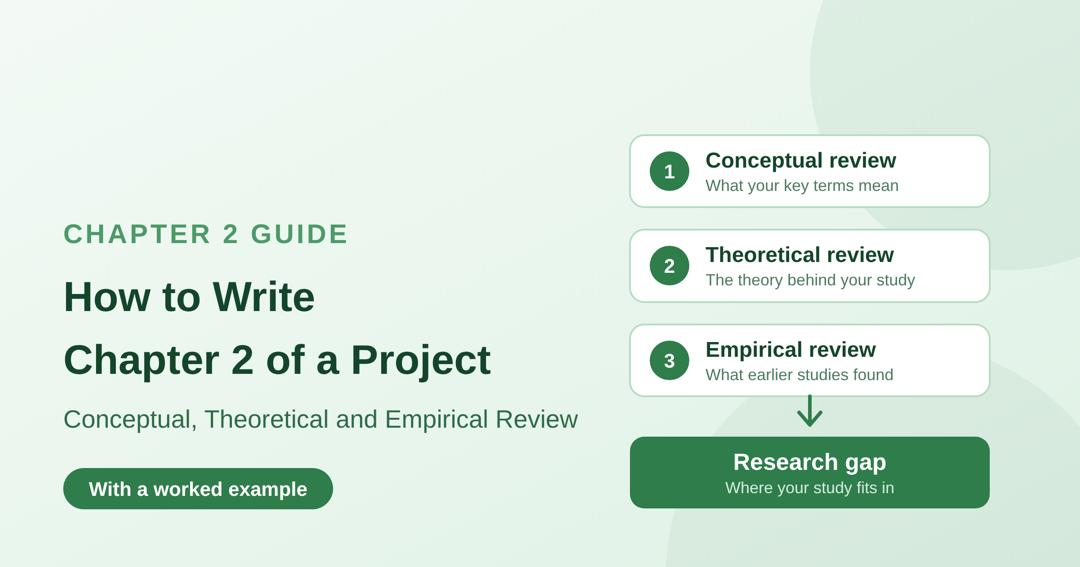
To write Chapter 2 of a project, build it in four parts: a conceptual review (what your key terms mean), a theoretical review (the theory that explains your topic), an empirical review (what earlier studies found), and a summary that points to the gap your study fills. Group sources by theme, not by author, and end every section by linking back to your research questions. This is the structure most Nigerian universities expect, and this guide shows you how to write each part with a worked example you can adapt.
Chapter 2 is where many final year students lose weeks. Not because it is hard, but because nobody explains what it is supposed to do. Once you understand its purpose, the writing becomes much more manageable.
What Chapter 2 is actually for
Chapter 2 is not a pile of summaries. Its job is to show your supervisor and your panel three things:
You understand the topic. You can define the key ideas and explain how they connect.
You know what has already been done. You have read what other researchers found in this area.
Your study is needed. There is something earlier studies missed, and your project addresses it.
If your Chapter 2 does these three things, it is doing its job, whatever your department calls it: Literature Review, Review of Related Literature, or simply Chapter Two.
The Nigerian three-part structure at a glance
Most Nigerian universities expect Chapter 2 to follow this order. Your department may add, rename or merge sections, so always confirm with your supervisor.
Section | What it answers | Typical length |
|---|---|---|
2.1 Introduction | What will this chapter cover? | One short paragraph |
2.2 Conceptual review | What do the key terms in my topic mean? | 3 to 5 pages |
2.3 Theoretical review | Which theory explains my topic? | 2 to 4 pages |
2.4 Empirical review | What did earlier studies find? | 5 to 8 pages |
2.5 Summary and research gap | What is missing, and how does my study fill it? | One to two pages |
↔ Swipe to see more
Step 1: Write a short chapter introduction
Open with one paragraph that tells the reader what the chapter covers and in what order. For example: "This chapter reviews literature related to mobile banking adoption and customer satisfaction. It is organized under conceptual review, theoretical review, empirical review, and a summary of the literature reviewed." That is all you need.
Step 2: Write the conceptual review
The conceptual review explains the key variables and terms in your topic. Take each main concept from your title and treat it as its own sub-heading.
For a topic like The Effect of Mobile Banking Adoption on Customer Satisfaction in Nigerian Commercial Banks, your sub-headings could be:
Concept of mobile banking
Concept of customer satisfaction
Mobile banking in the Nigerian banking sector
Dimensions of customer satisfaction (such as speed, security and convenience)
Under each sub-heading, do four things:
Define the concept using at least two or three authors, and note where they agree or differ.
Explain it in your own words so the reader sees you understand it.
Show how it connects to your study, ideally to a research question or hypothesis.
Add Nigerian context: CBN policies, local examples, and Nigerian data where available.
A simple pattern for each concept is: definition, what scholars say, how it applies to Nigeria, how it links to your study.
Step 3: Write the theoretical review
A theory gives your study a foundation. It is an established explanation of how or why something happens, and it tells the panel why you expect your variables to be related.
To write this section well:
Pick one to three theories that truly fit your topic. More is not better. Two well-explained theories beat five shallow ones.
Introduce the theory. State who proposed it, when, and what it argues.
Explain its main ideas in plain language, not copied wording.
Show its strengths and limits briefly. One or two sentences of critique show maturity.
Connect it to your study. This is the part students skip, and it matters most. Say clearly which of your variables each idea explains.
For the mobile banking example, the Technology Acceptance Model works well. It argues that people adopt a technology when they find it useful and easy to use. You would then explain that perceived usefulness and ease of use help explain why customers adopt mobile banking, and why that adoption may lead to satisfaction.
Quick guide for choosing a theory: Business and management projects often use theories such as Technology Acceptance Model, Resource-Based View or Expectancy Theory. Education projects often use Constructivism or Social Learning Theory. Mass communication projects often use Agenda-Setting Theory or Uses and Gratifications Theory. Ask your supervisor to confirm which fits your department's preference.
Step 4: Write the empirical review
The empirical review covers earlier studies that tested ideas like yours, with real data. This is usually the longest section, and it is where weak chapters show.
For each study you include, note:
Who carried out the study, and when.
Where it was done (country, state, institution or industry).
How it was done (method, sample, and tools).
What it found.
What it leaves out or how it differs from yours, where relevant.
Try to include studies from Nigeria, other African countries and beyond, and prioritize recent work from about the last five to ten years unless a study is a classic in your field.
Synthesize, do not just summarize
The biggest mistake here is describing one study after another: "Author A found this. Author B found that. Author C found something else." That reads like a list, not an argument.
Instead, group studies by theme and compare them. Compare the two approaches below.
Weak (summary): "Adeyemi (2022) studied mobile banking in Lagos and found it improved satisfaction. Bello (2021) studied mobile banking in Kano and found security concerns reduced trust. Okafor (2023) studied internet banking in Enugu and found speed mattered."
Strong (synthesis): "Several Nigerian studies link mobile banking to higher customer satisfaction, mainly through convenience and speed (Adeyemi, 2022; Okafor, 2023). However, security concerns remain a recurring barrier to trust, particularly in northern states (Bello, 2021). These studies, however, focused on urban customers, leaving rural users largely unexamined."
The authors above are made up for illustration only. Always use real, verifiable sources in your own work.
The strong version groups findings, compares them, and points toward a gap. That is what supervisors want to see.
Step 5: Summarize the literature and state the gap
Close the chapter with a short section that does two jobs:
Summary: In one or two paragraphs, pull together the main points from the conceptual, theoretical and empirical reviews.
Research gap: Say plainly what earlier studies did not cover. A gap can be a place that was not studied, a group that was ignored, a variable that was left out, a method that was not used, or a period that is now outdated.
You can use this fill-in-the-blanks sentence: "Previous studies have examined [topic], but most focused on [area/group/variable]. Few studies have examined [your focus] in [your context]. This study therefore seeks to fill that gap."
A worked outline you can adapt
Here is a full Chapter 2 skeleton for the example topic:
2.1 Introduction
2.2 Conceptual Review
2.2.1 Concept of Mobile Banking
2.2.2 Concept of Customer Satisfaction
2.2.3 Mobile Banking in Nigerian Commercial Banks
2.2.4 Mobile Banking and Customer Satisfaction
2.3 Theoretical Review
2.3.1 Technology Acceptance Model
2.3.2 Expectation-Confirmation Theory
2.4 Empirical Review
2.4.1 Mobile Banking Adoption and Convenience
2.4.2 Security, Trust and Customer Satisfaction
2.4.3 Studies in Nigeria and Other Developing Countries
2.5 Summary of Literature Reviewed and Research Gap
Copy this pattern and swap in your own variables.
7 mistakes to avoid in Chapter 2
Listing authors instead of building an argument. Group by theme.
Copying definitions word for word. This is how plagiarism flags start. Paraphrase and cite.
Using old or weak sources. Prefer peer-reviewed journals, textbooks and credible reports over random websites.
Choosing a theory that does not fit. If you cannot link it to your variables, change it.
Skipping the link to your study. End each section by relating it back to your objectives.
Having no gap. Without a gap, the panel asks why your study is needed.
Inconsistent citation style. Pick the style your department uses (often APA) and apply it throughout.
A quick reference: what to include in each section
Section | Must include | Common slip |
|---|---|---|
Conceptual review | Definitions, Nigerian context, link to your study | Only definitions, no link |
Theoretical review | Origin, main ideas, critique, link to variables | Describing a theory with no link |
Empirical review | Author, year, place, method, findings, gap | Listing studies one by one |
Summary and gap | Key themes and a clear gap statement | Missing or vague gap |
↔ Swipe to see more
A simple writing plan you can follow
Write your title and list your main variables.
Collect 20 to 30 sources and sort them by theme.
Draft the conceptual review first, one sub-heading per variable.
Choose and write up your theory or theories.
Write the empirical review, grouped by theme.
Write the summary and state the gap.
Check that every citation appears in your reference list.
Run a plagiarism check before you send it to your supervisor.
Where My Project Writer fits
My Project Writer helps you draft Chapter 2 without losing track of your sources. You can organize your literature by theme, keep citations aligned with your reference list automatically, and run plagiarism and AI-detection checks as you write instead of at the very end. It also saves your drafts as you go. Ready to start? Draft your Chapter 2 in ProjectWriter.
FAQs
How long should Chapter 2 of a project be? Most undergraduate projects have a Chapter 2 of about 15 to 25 pages, but it depends on your department. Ask your supervisor for the expected range.
What is the difference between conceptual, theoretical and empirical review? The conceptual review explains key terms, the theoretical review explains the theory behind your study, and the empirical review reports what earlier studies found using real data.
How many sources should I use in Chapter 2? Many supervisors expect at least 20 to 30 credible sources for an undergraduate project, though this varies. Quality and relevance matter more than the number.
Can I use Wikipedia or blogs as sources? It is best to avoid them as main sources. Use journal articles, textbooks, government reports and reputable publications, and use Wikipedia only to find leads to better sources.
Should I write Chapter 2 before or after Chapter 1? Many students find it easier to read widely first, then write Chapter 2, and refine Chapter 1 afterwards, since your objectives often sharpen once you have read the literature.
What if I cannot find studies on my exact topic? Use studies on closely related variables, similar contexts or neighbouring countries, then explain clearly why your topic is a gap.
What is a research gap, and how do I write one? A research gap is something earlier studies did not cover. State what was studied, what was missed, and how your study addresses it, as in the sentence template above.
A quick disclaimer
These guidelines reflect common practice across Nigerian universities, but every department and supervisor has its own requirements. Always confirm your department's format, citation style and chapter structure before you finalize your work. The sample authors and examples in this post are illustrative only.
Reviews
No reviews yet — be the first.