How to Write Your Final Year Project, Step by Step
ProjectWriter
September 9, 2026
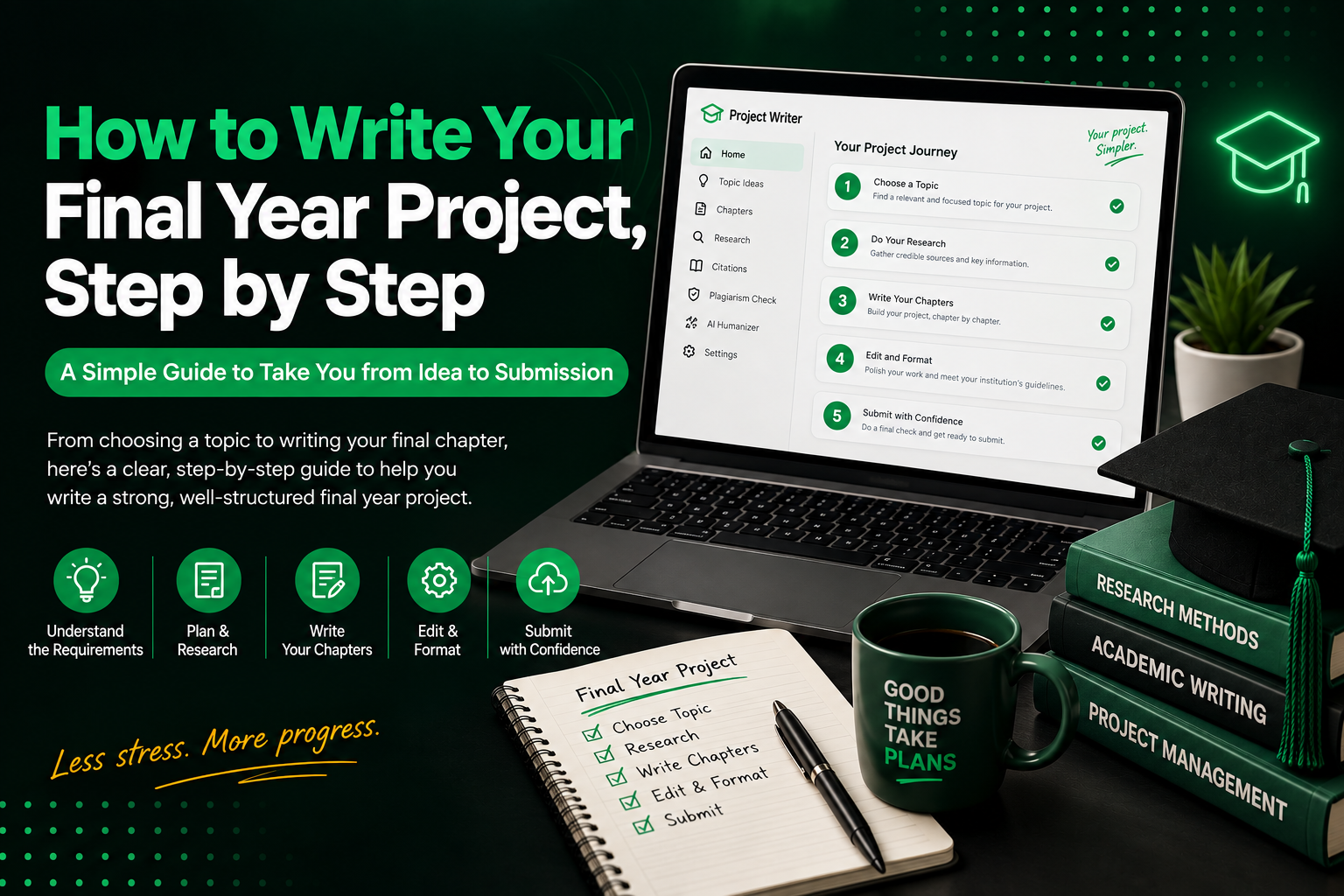
Final year projects in Nigerian universities follow a fairly standard five chapter structure, whether you're at UNILAG, UI, ABU, UNN, or UNIPORT. The departments differ in small ways, but the shape of the document doesn't change much. What separates a fast, painless project from a stressful one usually comes down to two things: starting with a topic your supervisor actually approves, and following your department's formatting rules from the first page instead of fixing them at the end.
Here's the structure most projects follow, and a practical way to move through it chapter by chapter.
The Standard FYP Structure
Preliminary pages: title page, certification, dedication, acknowledgement, abstract, table of contents, list of tables and figures.
Chapter 1, Introduction: background, problem statement, objectives, research questions, hypotheses, significance, scope, limitations, operational definitions.
Chapter 2, Literature Review: conceptual review, theoretical framework, empirical studies, and a summary of the gaps your project addresses.
Chapter 3, Research Methodology: research design, population, sample size, sampling technique, instruments, validity and reliability, data collection, and your analysis method.
Chapter 4, Data Presentation and Analysis: tables and charts, interpretation, hypothesis testing, and discussion of your findings.
Chapter 5, Summary, Conclusion and Recommendations: key findings, conclusions, recommendations, your contribution to knowledge, and suggestions for further study.
References: APA, MLA, Harvard, or Chicago, depending on what your department specifies.
Appendices: questionnaire, interview guide, raw data, ethical approval letters.
A Step By Step Way To Write It
Step 1: Get a topic your supervisor will actually approve
Most students lose the most time here, not because the writing is hard but because the topic keeps getting sent back. My Project Writer's Instant Topic Generation deals with this directly: put in your field, whether that's Mass Communication, Computer Science, or Accounting, along with your interests, and you get academic, field-specific topics in seconds instead of weeks of guessing. From there you can narrow it down, to one university or one local government area, before it goes to your supervisor.
Step 2: Build your chapter outline
Once the topic is approved, My Project Writer's Smart Structuring turns it into a full chapter by chapter outline that follows Nigerian university format: standard subheadings like 1.1 Background and 1.2 Problem Statement, adjusted for your project type, whether it's a survey, a system build, a lab experiment, or a literary analysis. You can add or remove sections so it matches your department's own template rather than a generic one.
Step 3: Draft chapter by chapter
With the outline set, the My Project Writer's Writing Assistant writes each section with you: paragraph suggestions that improve flow and clarity without sounding stiff or robotic, a formal academic tone that still reads like your own voice, and citations inserted as you go through the Citation Manager, formatted in APA, MLA, Harvard, or Chicago.
Step 4: Add the sections specific to your project
Not every project needs the same subsections, so My Project Writer lets you add extras where they're relevant:
Chapter 1: Operational Definitions or Ethical Considerations, if your department requires them.
Chapter 2: a Conceptual Framework diagram, or a Summary of Empirical Studies table.
Chapter 3: Pilot Study Results or Instrument Validation subsections.
Chapter 4: Hypothesis Testing or Discussion of Findings as their own subheadings.
Chapter 5: Limitations of the Study or Contributions to Knowledge, spelled out explicitly.
Step 5: Format it the way your department expects
Small formatting mistakes cost real marks, and they're easy to miss when you're focused on the writing itself. My Project Writer handles this in the background:
Times New Roman, 12 point, double line spacing, 1.5 inch left margin and 1 inch on the other sides.
Correct page numbering: lowercase Roman numerals for preliminary pages, Arabic numbers from Chapter 1 onward.
APA, MLA, or Harvard references formatted properly and exportable in one click.
A table of contents generated automatically with the right page numbers.
Step 6: Check for plagiarism and AI detection before you submit
Before your project goes anywhere near your supervisor:
Use the My Project Writer Humanizer to rewrite the draft in a natural academic tone and cut down on AI flags.
Export the final version as DOCX or PDF for review or upload.
Why This Order Works
What it gives you | Why it matters |
|---|---|
Speed | Topic to full draft in hours instead of months, since you're not starting each chapter from a blank page |
Accuracy | Formatted the way Nigerian universities actually expect, not a generic template |
Flexibility | Sections can be added or removed per chapter to match your department's own structure |
Integrity | Plagiarism and AI-detection checks built in, so originality isn't an afterthought |
↔ Swipe to see more
Starting with a supervisor-approved topic and moving through the chapters in this order is what actually saves time. Most of the delay in a final year project doesn't come from the writing itself, it comes from rework: a rejected topic, a wrong reference style, a chapter written before the outline was settled. Fixing the order fixes most of that.
FAQs
Do all Nigerian universities use the same five chapter structure?
Broadly, yes, though departments vary on the finer details, like which subsections are compulsory or which referencing style is required. Always check your department's own guideline document before you finalize your outline.
How long should it take to go from topic to full draft?
With a structured workflow, a first full draft in a matter of hours is realistic. Getting to a polished, defense-ready version still takes real review and revision on your part, which is worth budgeting time for separately.
Can I still customize my chapters if my department's format is unusual?
Yes. Sections can be added or removed per chapter, so you're not stuck with a rigid template if your department asks for something specific, like a pilot study section or an extra ethics statement.
Does formatting really affect my grade?
It does, more than most students expect. Font, spacing, margins, page numbering, and reference formatting are usually part of the marking scheme, separate from the quality of your actual research.
A QUICK DISCLAIMER
This structure reflects common practice across Nigerian universities, not a fixed rule. Confirm the specific format, chapter requirements, and referencing style your own department expects before you start writing, and treat any AI-generated draft as a starting point that still needs your own review and understanding.
Reviews (1)
Lolia N.
Sep 9, 2026More like this
Paraphrasing vs Plagiarism: What Every Final Year Student Needs to Know When Writing a Project
Learn the difference between paraphrasing and plagiarism, avoid common writing mistakes, cite sources correctly using My Project Writer to support your final-year project writing process with greater confidence.

How to Avoid Plagiarism in Your Final Year Project
What actually counts as plagiarism beyond copy-paste, why it happens to careful students, and practical habits to keep your final year project original.

How to Write a Literature Review
A practical way to structure your final year project literature review by theme, avoid the most common mistakes, and actually land on your research gap.
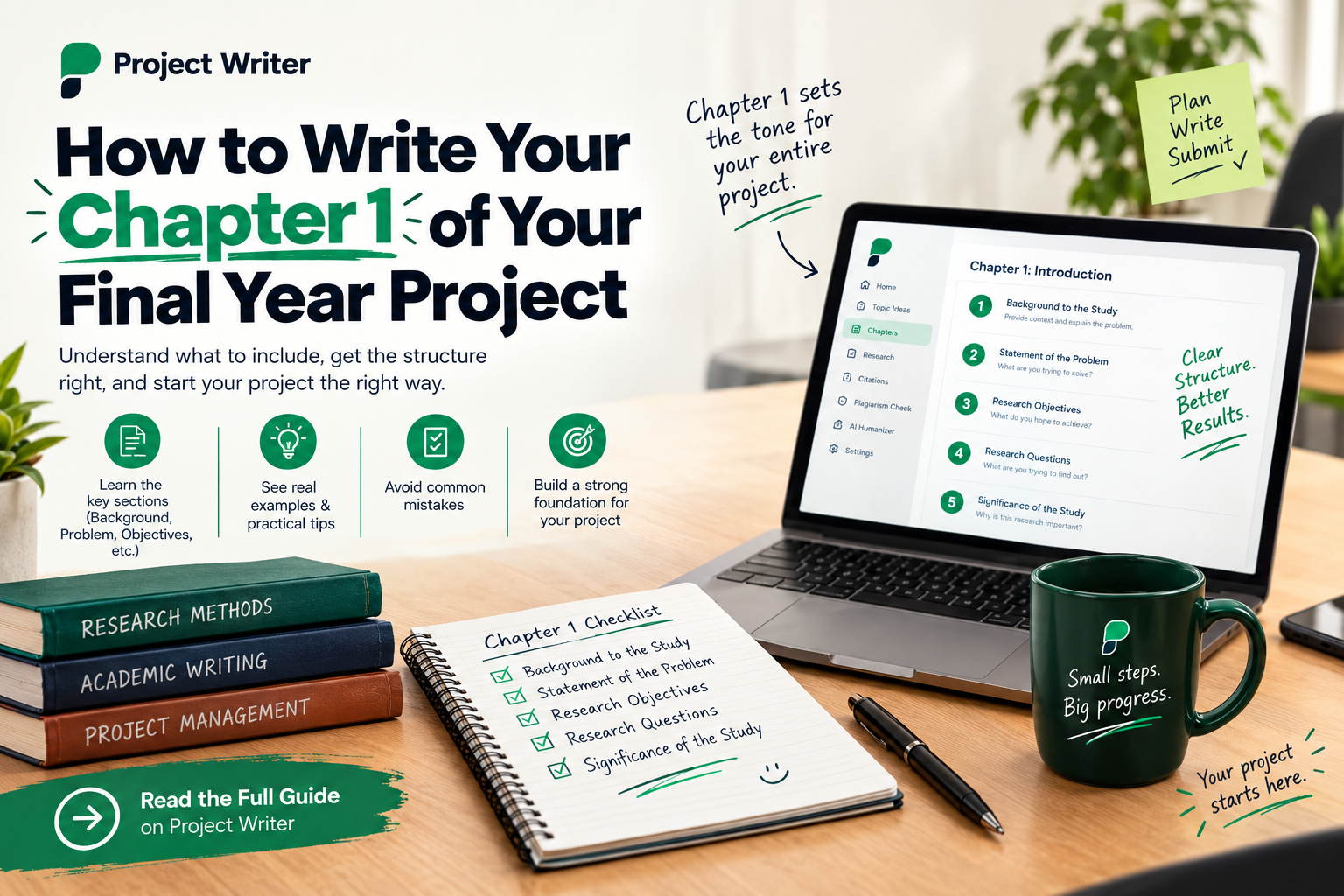
How to Write Your Chapter 1 of Your Final Year Project
A practical guide to writing Chapter 1 of your final year project, the standard sub-sections, common mistakes, and why writing it last often works better.